W E Patterson's avatar

Location, location, location

An author friend of mine, an author that has known some success, and knows more about writing than I do, told me that the setting for his latest novel is Long Island, New York. Having lived in Long Island for three years back in the early 80’s, I was intrigued.

“Really,” I said to him, “Nassau, or Suffolk?” He didn’t know how to answer, but he did tell me the name of a town that I recognized. I went on to tell him that I lived for a time in Huntington Station, New York, which is in Suffolk County. Then I pressed him about his regional knowledge of that area – not because I was trying to embarrass him, or impress him with my esoteric knowledge of Long Island, but because I was curious as to why he chose that location as the setting for a novel – especially since his novel did not have to be set in that location for any particular reason.

My author friend finally confessed that he had never been to Long Island, or even New York for that matter, but he told me with great confidence, that with the tools available on the internet, today’s author can set a novel in practically any location they choose. By using MapQuest to locate streets and by using Google Earth and Street View to zoom in on actual locales, one can effectively write a novel set in any particular area without ever having set foot in Westhampton, Shinnecock Hills, or Amagansett.

I retreated from the conversation unconvinced.  I recall an article that I read many years ago in a magazine. I cannot remember who wrote the article, but it was an interview with a successful published author. It was one of those advice type articles, directed at novice writers trying to write their first published work. There was lots of good advice in the article, but I’ve retained only the following:

“Never, ever set a novel in New York City unless you know the town.”

Notice that the writer was quite emphatic about this particular point. While the writer spoke only of New York City, I suspect that the advice might be expanded to include many other large metropolitan areas, like Los Angeles and Chicago.

The author went on to explain that New Yorkers buy lots of books, and since many New Yorkers have lived in the city all of their lives, they will smell a phony in…well…a New York minute. Don’t alienate the New Yorkers!

I suppose it depends somewhat upon the breadth of the creative piece that a writer is trying to develop. It would probably be possible to set a short story in say, an apartment on the Upper East Side of Manhattan by doing a bit of internet research, as long as the action doesn’t ‘leave the house’. Move your characters out onto the street, and then you’d better know the lay of the land. If your CIA agent meets her contact at the Feast of San Gennaro, you’d better, at some point in life, have walked Mulberry Street between Houston and Canal (something I have done, but I used the internet to verify that Houston to Canal Street part, thus highlighting my point that the internet is a useful tool for detail, but it does not take the place of the experience).

There are exceptions. Edgar Rice Burroughs, the author of the epic Tarzan series of adventure books wrote prolifically about Africa, without ever having set foot on the continent. It is important to note, however, that Burrough’s work was consumed by an early 20th century audience who, like him, knew little of Africa either. Perhaps the more sophisticated the audience, the more regional knowledge the writer needs to effectively create a believable piece (and unless we are writing pure fantasy, we all want to write a believable piece – that’s the goal, right?).

I am wondering how others feel about this very important topic. You have the plot, you have the characters. Now where do you put them? Is it your hometown, a place you visit regularly, or maybe where you vacation? After reading some Nicholas Sparks (trying to find out what that guy is doing right), I suspect that he knows quite a bit about the Outer Banks of North Carolina, and I doubt he learned all he knows by searching the internet. I mean, has Google Street View ever swept through Rodanthe?

Hemingway once reflected that it was difficult for him to set his work in his present physical location. He felt that his 1937 classic novel, To Have and Have Not, a novel set primarily in Cuba and Florida, would have been much better had he not written most of it while living in Key West. He found that he wrote best about places he had left some years before.

In my own work, I am finding that Papa was onto something. As a native Midwesterner, I find it easier to write to mundane cities out on the Plains (The DUI Guy is set in suburban Chicago), than it is to set my characters in Florida, where I currently live – perhaps I shall have to move to New York in order to write the perfect Florida book.

In any case, I would be interested in your thoughts.

Until next post,

Mahalo,

Ed

W E Patterson's avatar

Dog years

I have an old dog named Chamberlain,

We work together on nights Allie is away,

He’s blind in his left eye and he walks sideways,

Toward me as I sit hunched over the old Olivetti,

That I use to type poems on,

It’s in the corner of the sun porch that Allie,

Closed in last summer to keep out the snow.

He leans against me for support,

Old yellow head on my flannel pajamas,

Tongue hanging out. I feel his breath through the plaid,

He’s old and dying, but we both ignore it,

Dying is a rite of passage, like being born in a litter,

Or being born an orphan, or even like finding,

Yourself trapped, in  years of late,

In an old farmhouse – up in the Poconos.

Rites of passage, they kill us in the end.

Allie comes home from work at twelve thirty and finds us,

Me, the Olivetti, Chamberlain, and an unfinished poem.

Allie makes a fried egg sandwich for us,

And we eat it on the porch.

Chamberlain licks my paper plate clean when we’re done,

After that we all watch tv until dawn,

The unfinished poem waits for another day.

Before we go to bed, Allie cups her hands over his ears,

She draws his face close to hers, and says,

“He’s 98 in dog years, if he makes it three more weeks”.

——————————

Ed’s Note: I have not written much poetry in recent years, but I used to write quite a bit of it. I am in the process of sifting through a lot of the old stuff, seeing what I want to keep and what I don’t. My collection, titled “Wearing Earth Tones in a Savage Land” is in the works and will appear here for a nominal price (like free) in a few weeks.

Mahalo,

Ed

W E Patterson's avatar

Happy Birthday Mr. Tolstoy

Today, September 9th, marks the birth of Russian writer, Leo Tolstoy. Tolstoy who was born back in 1828, wrote, among many other classics, the voluminous doorstop, “War and Peace”. This novel, whose English translation word count runs slightly over half a million words is so lengthy, that it has come to symbolize an event that takes a long time to complete, as in:

“What’aya doin’ in there pal, reading War and Peace?”

To me, War and Peace symbolizes the Everest of reading challenges. Personally, I have attempted, and failed, to make my way to the summit, on not one, not two, but upon three separate attempts.

Attempt number one was when I was but yet in High School – my eyes were in great shape, and my reading moxie was at its highest. I had just finished reading Dickens’ Bleak House and I thought that I could tackle anything. Unfortunately, the maze of Russian names soon brought me to my adolescent knees.

Attempt number two was made in the summer of 1991. Having recently picked up a fine hardbound copy of this book at a yard sale for 50 cents, I’d just placed it on my bookshelf, with a mental note to pick it up and start reading it someday, when when my job abruptly ended and I had – well, lots of time.

Those were the days before computers and cell phones. After mailing out a stack of resumes to every company I could think of, the only thing to do was to sit back and wait for the phone to ring, and since all phones were tethered to the wall back then, I found myself virtually housebound throughout the business day, with little to do except, read War and Peace. And read I did, for the better part of a week, but in the end, I found other pursuits to fill my day, and my hardbound copy still sits on my bookshelf with a receipt from the Hackettstown, New Jersey Shoprite, dated July 17, 1991, serving as a bookmark. The receipt is tucked firmly into page 241 – a tiny pencil mark noting the exact spot where I left off.  I have not revisited this volume since.

My third and final attempt on the summit came in the winter of 1996 (or thereabouts, but it was winter). I was spending a lot of time on New Jersey Transit trains, riding back and forth from my home in New Jersey to my job in Manhattan. I had lots of time to read. This time though, I picked up a paperback edition of War and Peace, as it was considerably less bulky than the Bible sized copy on my home bookshelf. This time I approached War and Peace with fervor. I planned it carefully. I decided that 20 pages per day would be a reasonable goal. That would be 10 pages on the train riding into the city in the morning, and 10 riding home that evening. That shouldn’t be too bad, I decided. At that rate, I would finish it in about 72 days! I made sure that I always carried a golf pencil in my pocket so that I could jot margin notes. I was prepared.

This time I went deeper into War and Peace than I had ever gone before, but around page 300 or so, I could tell that I was losing my enthusiasm. Somewhere around page 400, or about 1000 pages short of completion, I misplaced my marked up paperback copy of War and Peace, leaving it for some other passenger on the NJT Gladstone line to pick up and enjoy. So if this is where you came across your copy of War and Peace, I hope that my margin notes helped. I also hope that you made it to the summit. I do not plan to attempt another ascent.

W E Patterson's avatar

…wondering…a salesman’s last night on earth…

On Saturday night, Tulip called me from L.A. Some of you who have been reading EEOTPB since the beginning remember her. She is an old friend of mine who moved from Florida to California several years ago.

She asked if I could find a poem that I wrote ten or a dozen years ago. It was about a close friend of hers.

I found it.

———————–

…wondering…a salesman’s last night on earth…

…I’m wondering how it is tonight,

Out on Bass Lake, and out in Spirit Lake,

And in Grand Lake and on the Great Salt Lake,

Down in Lake Charles and out on Lake Shore Drive,

How is…

The tiny girl named Janie from the Woodsmen,

Is she making out tonight?

Did she save the napkin, or the night, or the dream,

Would we have made it without screaming, just us.

How about the others, like,

The young hooker with her scrubbed cheeks,

Loaded on George Dinkel and telling me once again,

That she had found her love and was returning,

To Pomona to attend Community College with,

Her friend from the dance company…

…nurse comes in to reload the morphine drip.

…was there a fight in Juarez, or was it the girl Cynthia,

I was waking up in the back seat of a cab – on,

The Stanton Street Bridge at dawn,

Wondering if that call had been from Harry,

Back at the Sioux Falls plant. Not caring then,

Not me because of the tremendous high.

If we sold another six hundred thousand,

Color television chassis south of the border,

I could not have cared less…or more.

I love the figures, but not the change,

Just the bottom line people back at the office,

They love when the numbers fly by quickly,

But not me…too much road time to care,

My concern is for the common people,

They say…

…they say I won’t last until dawn

…and I think of her, a young lady married to a man

Who couldn’t keep a job, and who drank each night,

Until he was oblivious to her and her cares,

Dawn. What a name for such a lady -such a timid name.

The last part of the night, the darkest part, will take him,

That’s what they say behind the curtain.

But I wait here, shackled like a tethered brood mare,

Chained to the misery of my last night on earth.

“Give ‘em Hell Harry,” I exclaim to no one in particular,

And I watch dawn break over Kansas City.

W E Patterson's avatar

Quotes we carry

Social media is awash these days in quotes, and I have to admit that I am a sucker for a good quote, be it from a deceased politician, company CEO, famous author, or Hollywood celeb. We used to have to wait for pearls of wisdom to filter down to us through the print media, but now we have quotes that we are free to use, download, send to Facebook friends, Tweet, or incorporate into blogs, as I have here at EEOTPB upon so many occasions.

Quotes lift us up, they make us laugh, and they make us sound worldly when we’re really not. An appropriate quote, delivered with proper timing can make or break you in corporate America.

One afternoon, half dozing through a staff meeting, I was roused from near slumber by a stammering colleague who seemed reluctant to commit to a plan for a product delivery. Waiting for the proper entrance into the fray, I responded with one of my favorite quotes by General George Patton:

“A good plan violently executed now is better than a perfect plan executed next week.”

Of course I attributed the quote to the General before delivery. The response was at first a subtle chuckling that rippled through the room, but my manager smiled and told me he liked my attitude. By the way — my colleague was soon asked to leave the company, and although I can’t say I was fast-tracked to a corner office, I wasn’t dismissed either. If there is ever a quote that shows balls-to-the wall commitment to getting the job done it is that one (depending upon the situation, skip the word ‘violently’, you never know how that is going to be taken). So remember it, oh Corporate Drones.

But there are quotes that hit us where we live, aren’t there? Have you ever printed out a quote, trimmed it neatly, and folded it into your wallet, or pocketbook? Has a particular quote elevated itself to “wallet status” – something you want to keep near you, to refer to when you are not quite sure of the shaky ground upon which you walk, or the future into which you enter, ready or not?

Maybe your personal quote is hand written on a  post-it note, folded five times and tucked behind your drivers license just in case you need it someday, or maybe it is in your pocketbook, written in the margin of your DayTimer, or some such, but you know where it is so you can find it always – that’s the kind of quote I am talking about – one that makes you think about life in a way you always knew that it should be thought of, but that he or she said it so well, and so much better than you could have.

The quote that I carry with me is a quote from the classic 1949 novel by Paul Bowles, “The  Sheltering Sky”. Bowles, if you recall, was the only child of a New York City dentist, a father who, according to reports, was a harsh father who left Paul as an infant to die on a window ledge during a winter storm. Perhaps such harsh treatment as an infant infused young Paul with a unique outlook on life. The stark finality, and reality of this quote, has garnered it a place in my ‘electronic’ wallet and I refer to it daily, although I can recite it by heart:

Because we do not know when we will die, we get to think of life as an inexhaustible well. And yet everything happens only a certain number of times, and a very small number really.”

In this passage Paul Bowles goes on to suggest that in a lifetime we only watch the full moon rise perhaps 20 times…

If you have a quote that you carry with you and it means something special to you, please feel free to share it here.

Mahalo,

–Ed

W E Patterson's avatar

My post vacation thoughts…

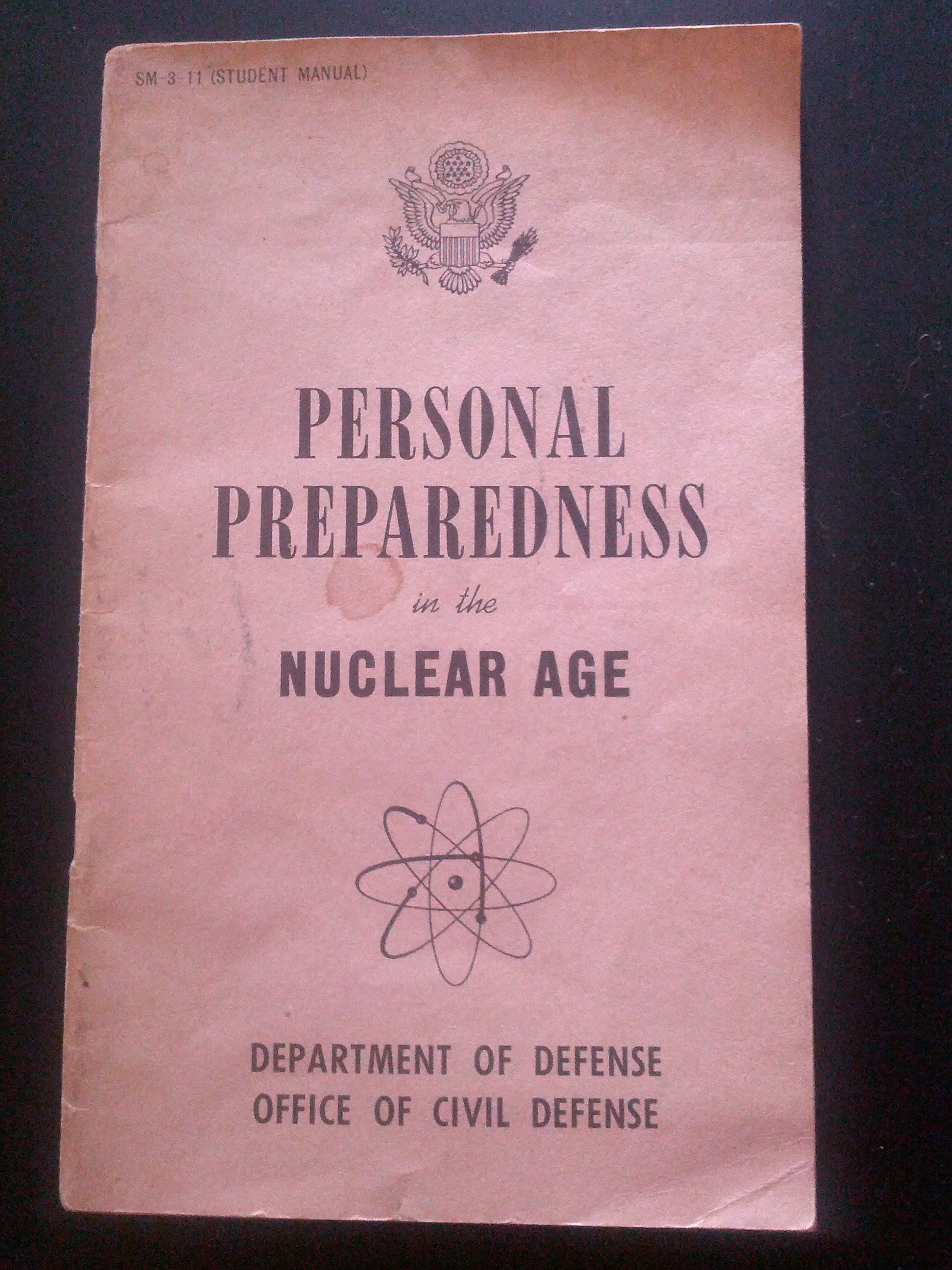
civil_defense_manualThis blog has suffered greatly these past couple of weeks, as professional demands, as well as lack thereof, have taken a toll on my writing schedule. Translated, that means that after working like hell for quite a while, I went on an eight-day vacation and didn’t write a line. Seldom do I vacate for eight entire days, but this year was an exception, and although I did not travel far (only 125 miles up the Florida coast), I was officially, ‘away’, and when I am ‘away’ I try not to touch a computer keyboard. This year I almost made it through without touching fingers to keys, and if it were not for the need to post an item for sale on Craigslist, I would have succeeded in keeping my vacation ‘computer free’.

I also try not to watch too much network news. I mean is there really any need to be completely informed on all matters at all times. Since there is little threat these days that ‘The Big One’ will be dropped on us at any time, I see no need to stay connected to international affairs 24/7. I recall reading a Civil Defense book that we had in our home when I was a child. I remember the chilling photos of the mushroom cloud rising over a distant city, as a family hunkered down in their well stocked fallout shelter, hopefully safe from annihilation in a wake of a gazillion megaton nuclear blast, that in reality would have vaporized them along with their supply of canned tomatoes and bottled water.

This particular Civil Defense guide went on to suggest that farmers take transistor radios to the fields with them during times of international tension, in order to monitor unfolding events. Presumably, they would be able to get the tractor tucked safely in the barn, should a flight of ICBMs be tracked coming in over the pole. Ludicrous indeed. As time went on, and the sixties unfolded into the seventies, these Civil Defense guides disappeared as we all accepted the grim reality that in event of such a man-made doomsday, there would be few, if not, any survivors.

Today, we seem to have little to fear from sudden and complete annihilation of the North American continent, however, our lives seem to be no more or less safe from destruction by events beyond our control.

The Orlando, Florida television stations, in the beachside community where I spent last week, preempted local news in lieu of live coverage of the George Zimmerman trial. Zimmerman, the armed community watch volunteer who seemed to go prepared for trouble, found it, and dealt with it using deadly force, is on trial for (what is effectively) his life. Meanwhile, the distraught family of the unarmed teenager felled by his bullet plead for justice. So it is a dangerous world, where walking in the wrong place, at the wrong time can mean deadly consequences. We are an armed nation, and there are lots of people packing heat and not afraid to use it – or maybe they just use it if they are afraid, who knows. Fortunately, this trial is coming to a head, and shortly justice will be served – hopefully.

Word of the tragic death of 19 Arizona firefighters came to me not over a network news station, but via The Weather Channel (TWC), as I tuned in one morning to ascertain whether or not the line of storms off of the Atlantic coast was a threat to the day’s fishing. I immediately turned to an NBC news report, delivered over my phone.

Finally, the crash of an airliner in San Francisco distracted me from fishing and beach.  As I paused to think for a moment about the two young girls who lost their lives in this ‘routine’ flight, and to consider how vulnerable we all are as we shoot through the skies from city to city aboard a mode of transport deemed safer than driving. Unlike the crash of the commuter plane in Buffalo a few years ago, in which the experience of the pilots is coming into question, this jet from Korea to the US had four pilots aboard for this long-haul international flight. The fact that it could crash upon landing, on a clear day, after making a successful flight across the Pacific Ocean is beyond belief.

The cause of this crash will take aviation experts, of which I am not one, months to investigate before a cause is determined. What I do find interesting is the news media’s continuing disbelief that the shaken passengers took time to gather personal possessions (even duty-free bags), before exiting the burning aircraft, as if these oblivious survivors put Ipods and scotch above human life as they malingered to gather earthly possessions. More than likely, these passengers were is shock in the few minutes immediately after dropping onto that San Francisco runway. I wrote a bit about this several years ago in an article about surviving a plane crash. You can read it here if you like.

So that’s it for now. Vacation is over, and I am back working and blogging. I am thinking about the fragility of life. As a new tropical disturbance crawls through the Caribbean I find myself thinking of how quickly our situations can change. If we are alive and relatively healthy we should consider ourselves lucky.

Stay safe.

Mahalo,

-Ed

W E Patterson's avatar

Revisiting James Jones…Fast writing…

I am reading a book that has been on my “To read” list for a number of years. “The Pistol”, the 1959 classic by one of my favorite authors, James Jones, has flown under my reading radar for the past decade or so. I once located a copy in a used book shop some years ago, but was forced to put it back when I was told that the shop did not accept credit cards. When I returned an hour or so later, with the required three dollars, the book was gone. I forgot about it for a long time, thinking that the book was probably out of print, but for some reason, the other day on a whim, I searched Amazon for it. I found that it is alive and well, with both new and used copies available, as well as a Kindle download. (I opted for the Kindle download.)

If you haven’t read much Jones, or if you haven’t even heard of him, the Illinois native wrote largely about his wartime experiences as a soldier in World War II, having actually been present at the Bombing of Pearl Harbor in 1941. His award winning novel “From Here to Eternity” which won the U.S. National Award for fiction ten years later, is heralded by some to be the finest work of fiction to come from the Second World War.

“The Pistol” is more novella than novel, running a scant 148 pages. It is a great read about a young soldier stationed in the Schofield Barracks (Jones’ old Army digs on Oahu). The book begins with the attack on Pearl Harbor and follows PFC Richard Mast during the turbulent early hours of the War, when it was perceived that the air attack was simply the prelude to an all out invasion of Hawaii. Anyone with an interest of life in the pre-WWII U.S. Army, or in military history will enjoy this book.

*

“A writer should write what he has to say and not speak it again.” So said Ernest Hemingway in Stockholm, Sweden in his written (although not personally delivered), speech accepting the Nobel Prize for literature in 1954.

I venture to suggest that for most of us, simply writing what we have to say is not easy. To help improve my own writing endeavors, I went searching for suggestions on how to improve my process. In so doing, I came across a great piece by Jim Denney about “Fast Writing”. It  deserves a reblog, so you can read it here. After reading this, as well as a couple of other blogs about “Fast writing” it begins to make sense. The longer that we tweak sentences, and adjust format (something we technical writers just can’t seem to get enough of), that little voice in the back of your writer’s head whispers to you, ever so gently, “this is crap…delete, delete.”

I truly think that Denney is onto something  here and I’m going to try it, as I continue with my latest work. I will note my progress here. In the meantime if you have any suggestions for keeping your story moving forward, and out of the trash, please feel free to comment.

Mahalo,

Ed

W E Patterson's avatar

A death at the Super 8

I have always felt that we need to do more for the men and women who have served our country. Or at least we need to do more than we are doing. Some years ago I wrote a poem about a vet that I knew. He was a Vietnam vet who came back from that war with a purple heart and little else. He was a friend, and his story touched me deeply. I wrote a poem about ‘Roger’ (full disclosure – not his real name).  Because this is Memorial Day weekend here in the United States, or ‘Decoration Day’ as my granddad, a World War I vet used to call it, I want to post this poem in ‘Roger’s’ honor.

A Death at the Super 8

Roger died at the Super 8, out on the edge of town,

Nobody left to bury him, his family long since gone,

His friends had all abandoned him, since he’d started talking strange,

Muttering about conspiracies, and weird lights out on the range,

Someone killed the Kennedys, and it ain’t who you’d think,

He told me in a local bar, after I had bought him his third drink,

Lots of things are going on, and the Feds are in the know,

Murders and black helicopters, drugs and UFOs,

He told me he heard people, whispering in his ear,

About the second coming, and it was happening next year,

He spoke in tongues, slept in the rain, and turned a ghastly pale,

A couple times he scared some folks, and ended up in jail,

The people who were close to him, all started to get scared,

So they started to avoid him, and they forgot they ever cared,

The welfare folks they finally found, a place where he could stay,

So he moved into the Super 8, and made the county pay,

But me and seven other guys, from the local Legion hall,

Turned out to see him buried, on a windy day last fall,

An Episcopalian preacher, who’d known him all his life,

Said Roger was a gentle man who’d always loved his wife.

He said it started years ago, when he couldn’t pay a loan,

A banker came down from Des Moines and took away his home,

His wife she moved to Keokuk, his son lives in Moline,

I heard he has a daughter too, but for years she’s not been seen,

He said he’d fought back demons, but now God would settle up the score,

And take away the agony of a man, who’d gone to war,

That night from fitful sleep I rose, and poured a shot of rye,

And drank a toast to Roger, and strange lights up in the sky.

W E Patterson's avatar

On the writer’s desk…

Recently, I lamented the sad, but understandable fact, that hard copy reference books, like the Dictionary and Thesaurus are becoming as extinct as ashtrays on the desks of today’s writer. The electronic medium has consumed these books alive, and I have got to confess that I too turn to internet search engines for precise word meanings and spellings. Although in my home office, I still have a four inch thick copy of Webster’s taking up shelf space, my office at the “place-where-I-go-to-make-money-writing” holds no such tome.

On my first day, on my first job, as a Technical Writer (more years ago than I like to admit), I received a very fine dictionary from The Company that hired me. It came packed in a large box of supplies that were handed out to new employees. It was packed  along with an assortment of pens of various colors (primarily red), a tightly bound pack of yellow legal pads, and an Xacto knife (for stripping line drawings into galley copy). There was also an ashtray, a very large ashtray with the seal of the U.S. Department of the Army embossed upon it. The ashtray was, of course, every bit as necessary as the dictionary as the very nature of the work (long hours pouring over electronic schematic diagrams and disseminating the intricacies of circuit flow onto the long legal pads), practically required a Technical Writer to burn through 20 to 40 cigarettes within the course of an 8 to 10 hour day – or so it seemed.

Today, thankfully the ashtrays are gone, the air is breathable, but the reference books are gone as well. So what is on my writer’s desk? On my desk, only four volumes remain. I thought that I might detail them here:

1. “The Elements of Style” by William Strunk Jr. and E.B. White. While this book has been around for over forty five years, I have shelved my previous editions in favor of the Penguin Press illustrated version (2005). This book is a necessity for anyone who writes more than their name on a check. I have found this book to be indispensable, my favorite chapter being the “Approach to Style” chapter. Here you’ll find advice on topics like: how to “write in a way that comes naturally”, “revise and rewrite”, “do not overwrite”, and “do not overstate”.

2. “The Scott, Foresman Handbook for Writers, Fifth Edition” by John J. Ruszkiewicz; Christy Friend; Maxine Hairston. Upgrade to a newer version if you want, but this version has served me well, and the good stuff doesn’t change much anyway. With just short of 1000 pages stuffed into a one inch spine, this brick of a book contains damn near everything you need to write like a real frigging professional. You will probably not find a more comprehensive (to the point of being exhaustive), book on the mechanics and rules of writing anywhere. The art of writing a draft, how to revise, edit, and proofread, sentence structure, grammar, how to begin a research project, it’s all here.

3. “Between You and I – a little book of bad english” by John Cochrane. This little volume was given to me by a friend (possibly one who thought I could use it). It has remained on my writer’s desk for several years now, and is the most entertaining, useful book about word usage that I have ever discovered. The book contains an Author’s Preface, followed by a Foreword by British radio journalist, John Humphries. From there the book takes off on an alphabetical listing of some of the most likely misused, misunderstood, and most often massacred words in the English language. Anyone interested in resuscitating what is left of the language should pick up a copy.

4.  “Ernest Hemingway on Writing” edited by Larry W. Phillips. Like “Hemingway on Hunting” and “Hemingway on Fishing”, and who knows what others, this book was probably manufactured to wring a few more dollars from this literary icon’s name. Still, the book offers some of the best and most inspirational writing antidotes to be found anywhere.  Starting with “What writing is and what it does”, this book contains Papa’s sage advice to all writers on such perpetually important topics as what to write about, work habits, proper use of obscenity, thoughts on other writers, and politics. What more do you need to know.

“It wasn’t by accident that the Gettysburg address was so short. The laws of prose writing are as immutable as those of flight, of mathematics, of physics.”

-Ernest Hemingway in a letter to Maxwell Perkins 1945

That’s all for today,

Mahalo,

Ed

W E Patterson's avatar

No more predictions of doom from me…

Unless it is my own death, I am through predicting the death of anything. Recently, I have written here about the forecast demise of poetry and the short story. As a result, I have received some really great commentary from readers who have convinced me that both mediums will probably outlive me. Thanks to all for your comments. I also read an interesting piece about the impending death of classical music, although I can’t seem to find that article right now, but if I do locate it, I will post it later. Since my musical knowledge is practically zilch, however, I don’t feel the least bit qualified to write anything on that subject anyway, so there you go.

Reference books are another matter, because I know something about them, having been a faithful user for many years. I am talking about real hard-core reference books like the dictionary and the thesaurus to name two. At one time I thought I heard the death knell of both, as words are so easily looked up online, but now I think I was being a little hasty. For all I know, the kids of today will have grown tired of electronic gadgetry and will have gone back to writing with quill pens and relying on town criers for news reports – but I doubt it.

A noontime visit to the last remaining bookstore in my area (or at least within lunchtime driving distance), has convinced me that at least one reference book – if not the ultimate reference book, will survive any event short of Armageddon. I am talking about the cookbook. I know, you can get any recipe known to man online, but I have a feeling that cookbooks are still going to survive, if not thrive. Cookbooks appear to be selling well, a fact that has been attributed to families eating at home more often due to the slouching economy, but I don’t think that is the reason at all. Families in financial distress do not often have $34.99 to plunk down for the 2013 edition of The Twenty Minute Mediterranean Gourmet. To the contrary, I would think that families feeling the economic strain would tend to look toward online sources for recipes on the cheap.

Cookbooks tend to have long life spans, often being handed down through families from parent to child. They have tattered pages, with smudges left from long dried smatterings of tomato paste and egg whites. Sometimes the faint scent of garlic wafts off of the pages when they are first opened after being closed for a long while and a careful inspection of the cookbook might reveal a calcified flake or two of ground marjoram in the page crease of the “Cornwallis English Turkey Stuffing” recipe. Most cookbooks have beautiful pictures of the expected resultant dish on the left hand page, and details on how to prepare it on the right –technical writing at its purest form.

There are usually lots of bookmarks in cookbooks. Torn out recipe pages from magazines work well for this, so even if you don’t know exactly where that recipe for “Aunt Madge’s Eggplant Rollatini” is – the one that your mom clipped from the June issue of Better Homes and Gardens back in 1968, you know that it is there somewhere in the cookbook, perhaps flagging the page for “Ben’s Mountain Home Chili”.

Unlike dictionaries and thesauruses that are used in the den, or the office, for stodgy tasks like preparing school papers, compiling work reports, and composing formal correspondence, cookbooks are used in the room that is closest to the human heart, the kitchen. Even if we know that recipe by heart (because we’ve made that dish five hundred times), do we really feel comfortable trusting dinner to chance? Of course not – it’s best to consult with Betty Crocker just to make sure that we don’t over-salt the pickled beets. So you will find yourself digging out the cookbook from wherever it is kept. Likely you will find it atop the fridge, above the spice rack in the pantry or on the back porch shelf flanked by the potted geraniums.

Wherever your cookbooks are stored, they will probably be stacked and not shelved, and everyone knows that books that are stacked have a longer life expectancy than those that are shelved. My Chilton auto repair manuals are a good example, having been stacked on a corner of my workbench for the better part of a decade.

But as I said at the beginning of this, I won’t be forecasting the death of anything from now on. There is too much other stuff to talk about, and it is already May.