There is no ‘flannel season’ where I live. Around these parts it stays in the 85-degree range until – Christmas, or thereabouts, so it is sometimes difficult for me to remember just where we are in the seasonal cycle.
October 2023 – can’t be. As you get older, the months seem to travel quickly, but this one really crept up on me. So, I intend to enjoy every day of October 2023, because the next time we see an October pop up, it will be in 2024 and we (in the US) know what that means. By next year, at this time, we will be in the death throes of US Presidential election, number 60. And what an all-consuming contest it is bound to be, divisive, ugly, and devoid of civility. But that is to come, and this is the here and now.
So, I intend to enjoy every day of these sweet October days below the frost line. We haven’t leaves to turn color, but we have rockets lighting our skies every few days as we reach out for the moon, Mars and beyond. Rocket launches have become so commonplace here on the Space Coast that we often forget they are scheduled until we see the plume of smoke in the sky and feel the sonic boom rocking the house. Just another day here.
So, what poetic offering do I have to celebrate October of 2023? I didn’t think I had one, but I do, so here it is. It was written several years ago as I sat on a Florida beach:
OH OCTOBER
Oh October, you have tracked me down like a contract process server, with envelope in hand, rushing toward me as I sit helpless, on Ft. Lauderdale beach, toes in granite sand, Ray Bans angled into fading afternoon sun. You hand me the price that I’ll pay: No shady drive leaf peeping bright New England autumn cider sipping pumpkin picking pre-ski crisp air from Ontario blowing across the Lakes orange and yellow tinged afternoons. With brandy and conversation before the first fire. Just remanent heat here beach-side last hurricane of the season, six hundred miles offshore.
In today’s world, with so much tragedy and disfunction going on around us, I think that sometimes we need a bit more frivolity in our lives. Sometimes instead of trying to write the Great American Novel, or write the world’s best poem, simply sitting back and writing something totally silly and worthless can be of value.
Hence the topic of today’s blog. I’d like to mention the value of ‘silly’ poetry. Silly poetry can be a great stress reliever. I discovered the value of silly poetry years ago. My paying job as a technical writer can be stressful, to say the least. Tight delivery schedules, unresponsive management, endless meetings, and long hours can all take their toll on a writer. One time, many years ago, very late at night, while working on a particularly challenging project, I became frustrated and, on a whim, I simply opened a blank Word document and began writing the most nonsensical poem that I could think of. I don’t remember much about the poem. I don’t even remember if I saved it. But I do know that the poem totally removed me from the technical document that I was working on, and when I returned to the technical material, I was mentally refreshed. After that time, I continued to write silly poetry now and then.
So, are there any ‘rules’ to writing ‘silly’ poetry. No. It wouldn’t be silly if there were rules. But generally, a silly poem should:
Make some attempt at rhyming. No stress about that though. Lame rhymes are OK.
Be totally spontaneous – if it doesn’t come easy, forget it. And NO rewrites!!! This poem isn’t going anywhere.
Be relatively short – nobody needs a rhyming spontaneous poem that goes on forever.
Which brings me to my latest silly poem. It all started about ten years ago when I listed a pair of cowboy boots for sale on eBay. I purchased the boots in the mid-90s before my wife and I left the North Country and moved to South Florida. They were a great pair of boots, but South Florida is not ‘boots’ country. This is flip-flops and sandals country. Therefore, my boots remained in our closet taking up space for years before finally, at my wife’s urging, I decided to part with them. I listed the boots on eBay for $100, about a third the amount I paid for them, thinking they would be gone in a week. But that didn’t happen. Nobody wanted my boots. A year passed, then another year – until I forgot about the boots. My boots languished on eBay and in my closet. Then one day, I remembered them and lowered the price to $50. That should do it, right? Naw – the boots wouldn’t sell. Nobody wanted them. Finally, before dropping the boots off at Goodwill, I lowered the price a little. Again, nobody wanted the boots…until last week…
Driving home from an evening out on Saturday, the familiar eBay cash register went off on my phone: ca-ching! You’ve made a sale. When I got home and checked my account, I was shocked to find it was the boots that sold…after all these years.
“They’re going to Fresno, California,” I told my wife.
“Good,” she said. “I think they will be happy there.”
And so, if you are a reader in Fresno, and you have just ordered a pair of cowboy boots from an eBayer in Florida, this silly poem is for you. Enjoy the poem and the boots:
My boots have gone to Fresno.
My boots have gone to Fresno But in F L A I’ll stay UPS picked them up today they’re on a westbound highway.
Thru rain and hail, and twisters and sleet they’ll be a whole lot happier now on someone else’s feet.
I’m scribbling stanzas of wild eyed poetry, hasty words jotted across the page of a spiral bound notebook. April damned near faded into May, a young girl stretched face down on an orange blanket, waves rumbling in from Wast Africa tumbling over and over words of distant explorers still pressed against the hot breath of the distant Sahara.. to end here, in late spring in Ft. Lauderdale.
A lady of middle years squeezed into a lavender bikini reads romance, digs her toes into the wet sand, hot breath of melanoma muttering Sun gods frighten her for a moment but she hastens back to the beach read…
I write another stanza but it is so hard. What about an easy beach read for a change. What about a simple clean exit. Include the best of the best, don’t miss anything. A book missing its last chapter is failure.
Louis L’Amour rides again at the Cat 5 Bar, a shirtless overweight local sips a Mai Tai as he reads oblivious to the churning the humming the hot beach beat pounding surf. Hot iron on the high plains, hot sand more hot, hot. hot.
It’s cool inside now says the last smoker in North America as she exhales a white/blue plume of 1950s Americana into the lifeless afternoon air, and she’s waving the only newspaper in the western hemisphere. She says she’s despondent because of the rental market. Screw the investors she says. And screw the politicians and the Russian oil oligarchs. Read the papers, they’re taking over. They’re coming in now like daylight through the blinds of a cheap motel — and they’re driving up the insurance rates.
A man of the cloth passes by like a grey ghost of the Apocalypse. A worn King James Version under his arm, pamphlets in his hand, hot in a dark jacket and dark pants and white Sam Smith sneakers. Have faith he says, to no one in particular.
“There are two motives for reading a book; one, that you enjoy it; the other, that you can boast about it.” –Bertrum Russell.
The above quote comes to mind whenever I think of James Joyce, and his classic work, Ulysses, and my inability to plow through it. My failure to do this was only highlighted by a recent trip to Ireland that my wife and I made in June, a trip that coincidentally coincided with Bloomsday, the annual June 16th celebration of Ulysses and everything James Joyce related.
I have tried to push my way through Ulysses for many years. It’s only 265,000 words, right! But thus far my efforts have been in vain. I have the same problem with War and Peace — a mighty tome that rings in at just over half a million words, nearly double that of Ulysses. But if I never make it through WAP, I don’t feel it will be a big deal. But I always wanted to finish Ulysses. Maybe I feel more of a kinship with Joyce than I do Tolstoy, I don’t know, but I surely thought a pending trip to Dublin, which would plop me in that city on June 16h, would be motivation to finish reading this book and I could boast about it later. But that didn’t happen. Even the most cordial, helpful, YouTube instructors couldn’t motivate me. I’m a lost cause.
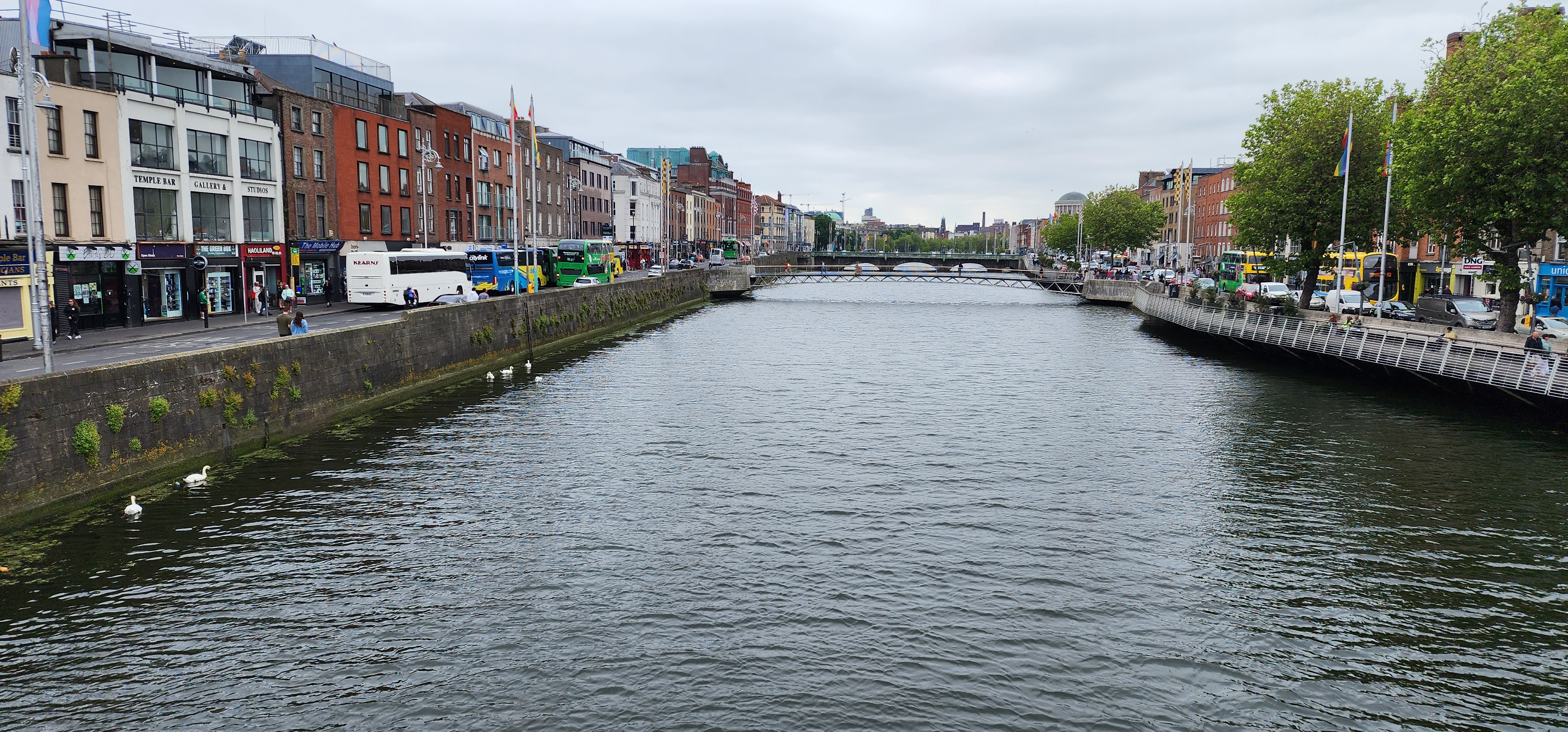
But getting back to Bloomsday, it’s a blast if you can make it. Dublin is a wonderful city and June is a great time of year to walk along the banks of the river Liffey, shop, dine, drink, and consider all things literary.
My wife and I got up on the morning of June 16th at crack of dawn (ok, maybe not that early), ready for Bloomsday 2023. Did I mention we have T-shirts – yes, we both have Bloomsday, Dublin T–shirts. Hey, nobody says you must finish Ulysses to buy the shirt!
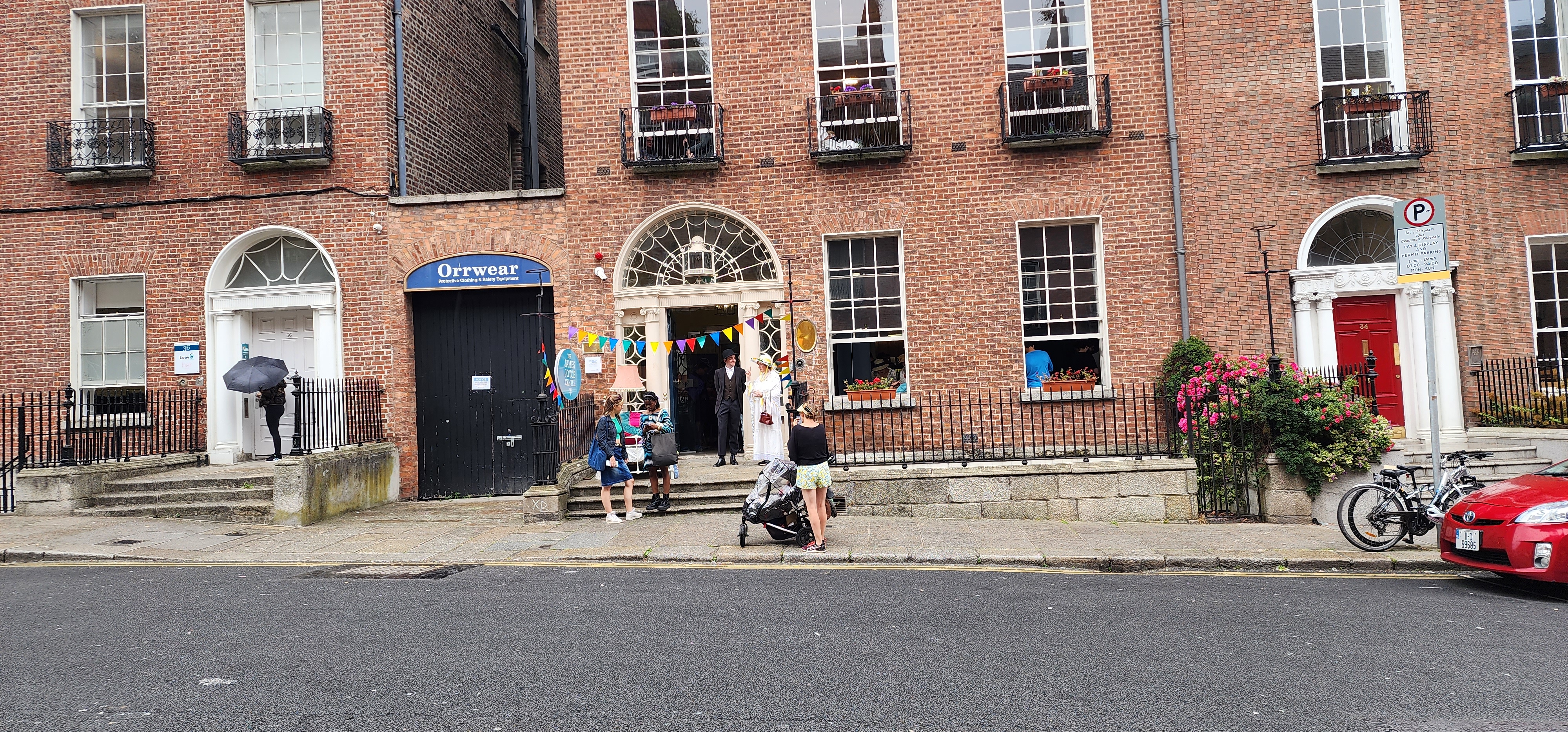
After a quick breakfast at the hotel, we grabbed an Uber and headed up to the James Joyce center on the north side of the Liffey. Twenty minutes later, it was threatening rain as our driver dropped us off in front of an elegant 18th century townhouse at 35 North Great George’s Street – the James Joyce Center. Already a crowd was beginning to gather, everyone in turn of the century attire.
The James Joyce Center is an incredible place to visit even if it’s not Bloomsday. Undeterred by my failure to complete Ulysses, we headed inside to enjoy this remarkably preserved home. In the gift shop, I peruse James Joyce books of all sizes and topics. Many are scholarly works for serious literary types – not me – I haven’t finished Ulysses (yet). To my right, a couple of university students from North Carolina discuss Ulysses esoterica with the shop clerk. I picked up a heavily annotated copy of Ulysses from the shelf. Footnotes abound. Hmm…maybe this is the copy I need. I’m obviously reading an incorrect version. Maybe more footnotes would help clarify the text. The book is 40 Euros and weighs about 80 pounds. I think of my already overflowing carry on bag and decide against the book, but I make a note of it for the future, should I tackle Ulysses again.
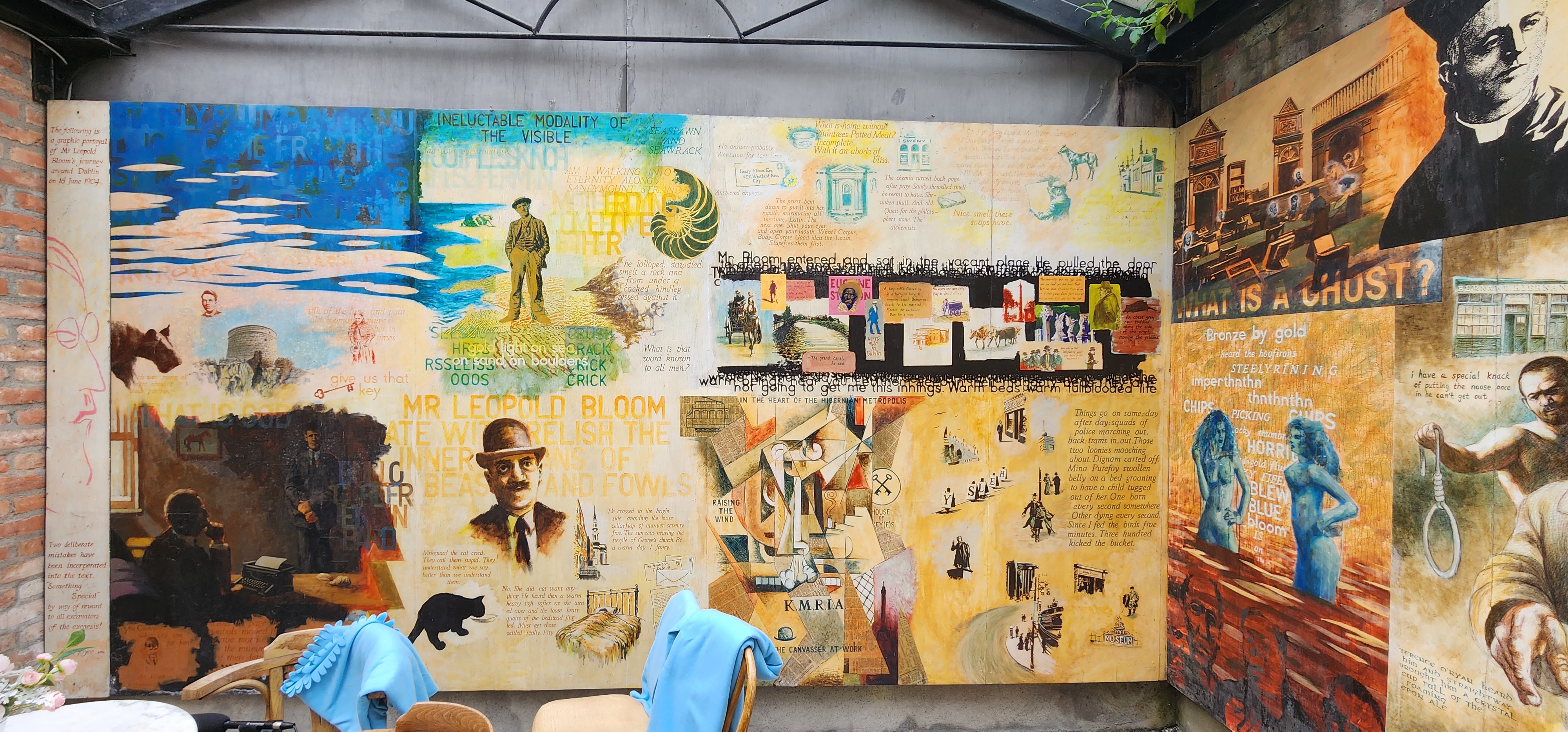
The courtyard of the James Joyce Center is my favorite part of the house. The painted murals that surround the courtyard depict the 18 episodes of Ulysses. All were painted by Paul Joyce, the great grandnephew of James.
Also on display in the courtyard is the original door from No. 7 Eccles Street. Even Ulysses ‘dropouts’ like me will recognize this as Leopold and Molly Bloom’s address. The original house that was attached to this door was razed in the 1980s to make way for expansion of a nearby hospital.
It started to rain harder as we left the James Joyce Center. We waited for a ride-share in the foyer of the Center. There is a Ulysses reading taking place downtown and we want to find it.
“It’s sometimes hard to get a ride from here,” says a bespectacled gentleman in early 20th century attire. Well noted. We waited another half an hour for a ride. Eventually a red Nissan pulls up. Our driver is a pleasant girl from China who has lived in Dublin for five years and hopes to go home next year to visit her family.
She drives us down to O’Connell Street with some vague directions about how to locate the reading. It’s not hard. Just look for lots of people dressed like it is 1901 in Dublin.
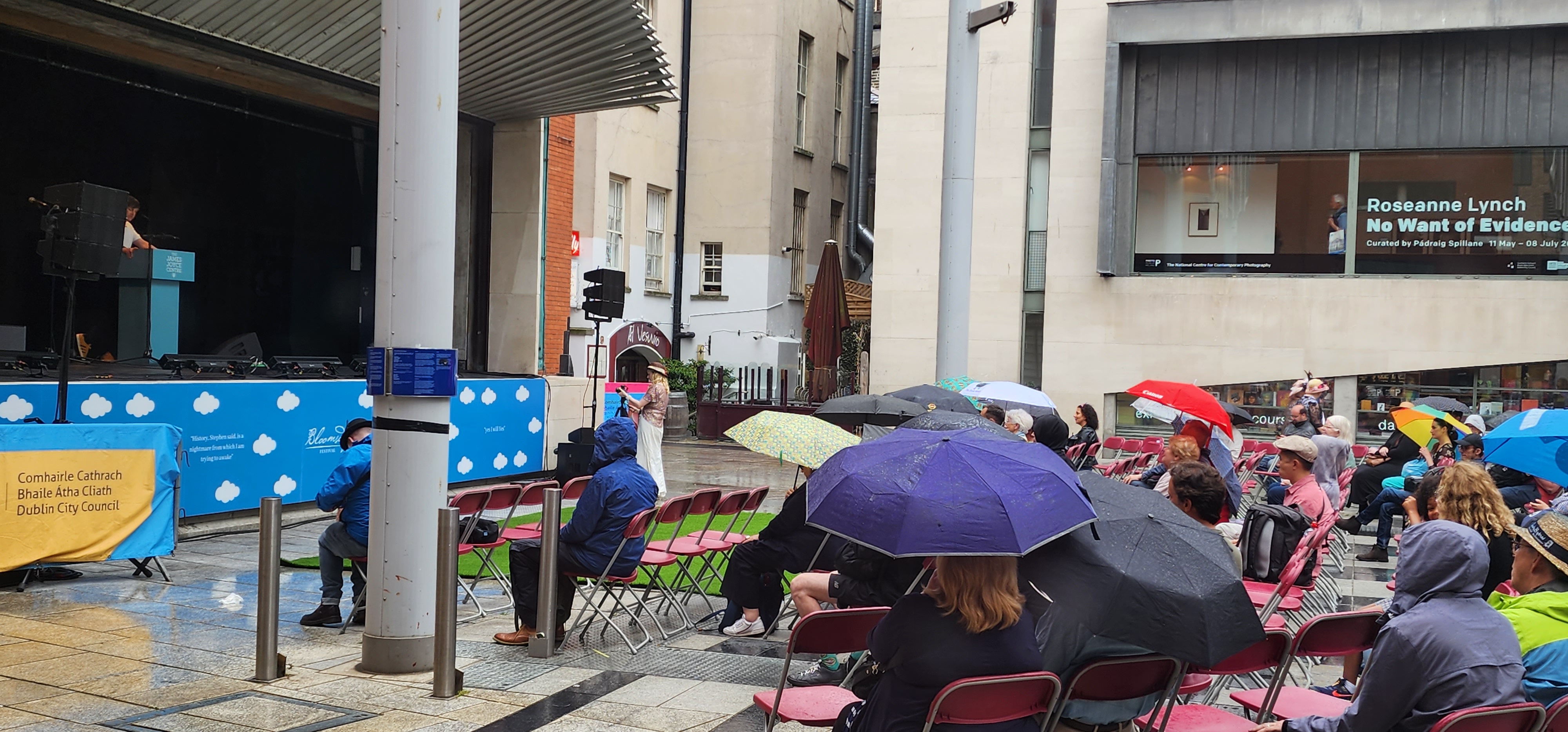
The reading takes place in an open courtyard. There is a covered stage set up along one side of the courtyard and many attendees are seated in metal folding chairs. Many are sitting with umbrellas. Others mill about under a canopy at the rear of the courtyard. We find a dry spot under a store awning within earshot of the speaker and try to stay dry.
A Joyce scholar is reading from Ulysses. Some in the crowd are so familiar with the book that they have committed passages to memory. Their lips move as they follow along with the speaker.
The rain picks up. I listen intently to the speaker, trying to determine which of the 18 Ulysses episodes he was reading when my wife taps me on the arm.
“Let’s go to Davy Byrnes,” she says. “I want to get out of the rain, and I am hungry.”
Davy Byrnes, at 21 Duke St, was Mr. Joyce’s favorite watering hole. It’s not far. We weave our way down Duke Street through a throng of men in black suits and straw hats and women in floor length skirts.
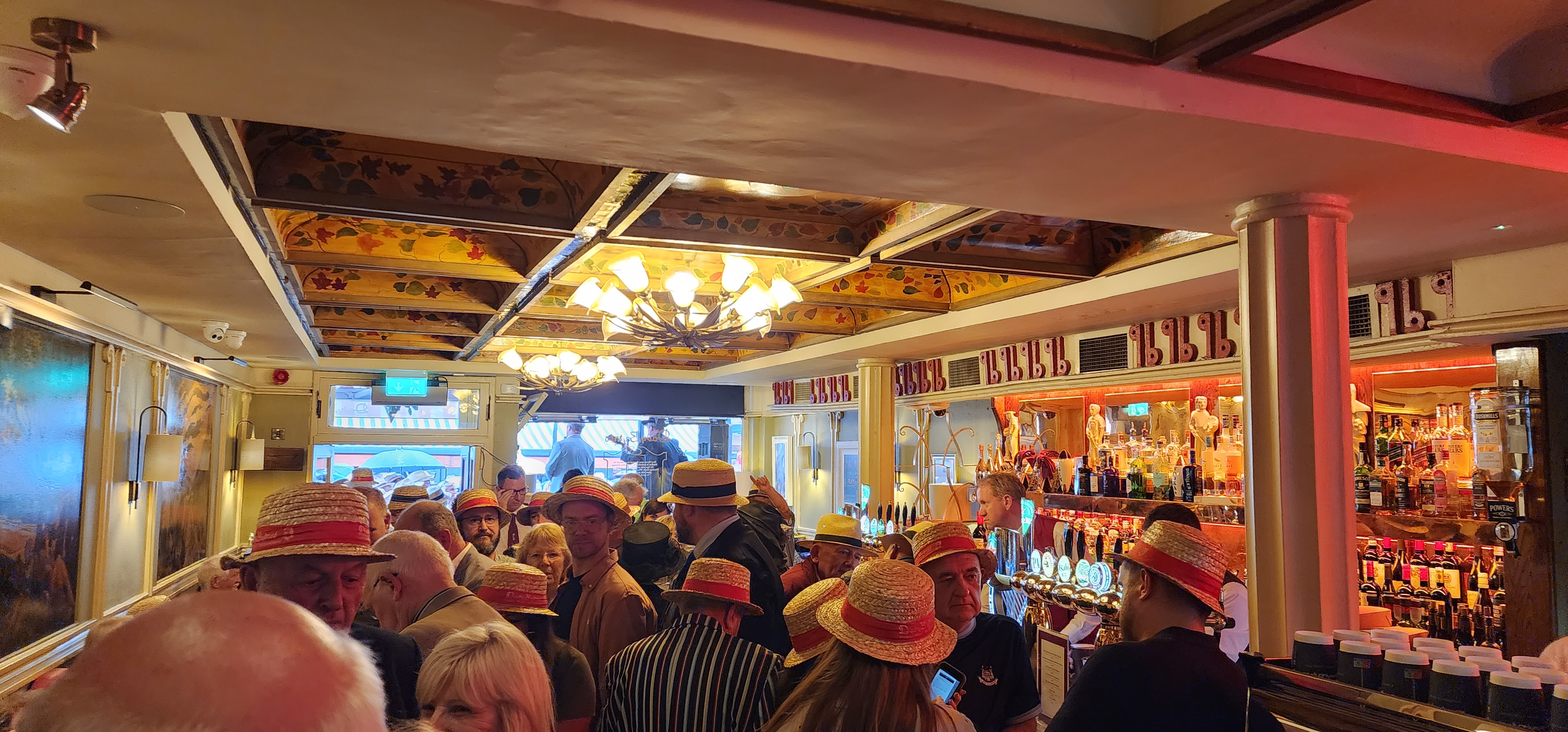
But we find that Davy Byrnes is impossible to navigate. There is a band playing on the street and the crowd has spilled out into the rain. We inched our way inside – there is no chance of grabbing a quick drink at Davy Byrnes on Bloomsday. I stop long enough to snap a quick picture:
Hungry for lunch and weary of the crowds, we headed back across Duke Street to The Bailey Café and Bar. The place is packed but it’s not like Davy Byrnes, probably because there is no indication that James Joyce ever drank there. But is a warm and friendly place, like just about every pub in Dublin. We ordered beer and sandwiches.
After lunch, we headed back to the south side of the river Liffey and after a few stops on the way to pick up some Bloomsday souvenirs, we arrived back at our hotel a little tired from Bloomsday but glad we had the experience.
A couple of days later, we flew back to the U.S. The day after our return, one of the first things I did was take my copy of Ulysses down from the bookshelf. There was my bookmark, exactly where I left it when I had started my third or fourth attempt to read this book. The bookmark was still tucked into page 57, which is the beginning of Part II, in which protagonist Leopold Bloom sits down to dine upon the “inner organs of beasts and fowls”.
I am busy with morning when I hear the news: Two billion new galaxies have been discovered.
They’re thirteen billion light years away. Thirteen billion. I try to calculate it. In my head I take a hundred years and take that times ten, and that’s a thousand. Then nine hundred of those and… it’s far too much. I’m thinking of centuries as I spread peach marmalade on my toast.
I think of the number of years between the pyramids and the Hoover Dam.
I think of the years between Nero and Woodrow Wilson. I’m unable to wrap my arms around it, so I give up…
ii
There is a bird outside my window. It is a nuthatch. I know that because my grandmother pointed one out to me half a century ago. Fifty years ago.
A nuthatch, a piece of toast, and two billion new galaxies. My wife comes into the kitchen – she’s looking for the coffee creamer and she hasn’t slept well. She says it’s because of blue light and how she shouldn’t peer into a computer screen before bed.
I tell her about the two billion new galaxies and the endless planets that might be circling stars and there might be nuthatches and peach marmalade elsewhere in the universe. And somewhere, perhaps another grandmother is pointing out birds.
In writing this blog today, I was reminded of a story about the author James Joyce. According to the story, a close friend of Joyce’s called on him one afternoon as Joyce was in the throes of writing his opus magnum tome, “Ulysses”. The friend found Joyce despondent and depressed. When the friend asked Joyce what was wrong, Joyce replied, “the work, that’s what’s wrong. It’s always the work.”
After some probing, the friend discovered that Joyce was depressed because he thought writing the book was taking far too long.
“How many words have you written today?” asked the friend.
After thinking for a moment Joyce replied, “Five, I think. Yes, I’ve written five words.”
“Well,” said the friend trying to be supportive, “that’s something isn’t it. Five words are better than none.”
“I suppose,” said Joyce, “but I just don’t know what order to put them in.”
It is a great thought. Words in their raw form are just expressions that are meaningless until assembled into the correct order. All that separates “War and Peace”, or Joyce’s “Ulysses” from any novel in a publisher’s slush pile is simply the arrangement of the words. Just hand someone a dictionary and say, “now go write a best seller – here are all the words”. I could go on and on with this, but I won’t.
What I want to talk about today is ‘blackout poetry’, because blackout poetry is all about word arrangement. And no, blackout poetry is not poetry written after having a few too many at your local watering hole. Not at all. Blackout poetry is poetry that is created when a poet takes an existing piece of text and covers, or ‘blacks out’ most of the source text, leaving a smattering of words exposed on the page to form a poem.
The blackout poet can use any piece of existing text that they want. It could be an article in a magazine, a page from a paperback novel or even a classic like “Ulysses”. Most poets look for a theme for their blackout poem. Usually, they start by looking for a word or two near the beginning of the page, and then they try to find other words throughout the page that enhance the imagery that they are trying to project.
If you are interested in writing your own ‘blackout poem’ here is what you need to do:
Decide on your source text — This must be a physical piece of paper. If you use a page from a book, you will probably need to cut the page from the book, so be aware that the book will be permanently damaged. Or you can do as I did when I wrote my blackout poem – simply download a page from the internet. There are lots of blackout poetry free sites that allow you to download pages.
Read the page carefully two or three times– Look for words or short phrases that seem to call out to you or seem to fit well with other words on the page. When you see these words, circle them lightly using a pencil. Look for words that seem to build on each other to enhance your theme.
Create your markup – When you are satisfied with the words you have selected for your poem, read them until you are satisfied with them. The length of the poem should be about 15 words, give or take a few words. When you have finished your poem, use a black marker or dark crayon to obscure all the text except the words to your poem.
Share your poem – You will need to take a picture of your poem or scan it into your computer. This is unique to blackout poetry. You must take a photo or scan of your poem for it to qualify as a blackout poem.
Of course, I will include here my first effort at blackout poetry. I used as my source file, a page from F. Scott Fitzgerald’s, “The Great Gatsby.”
NOTE: As the readability of this blog sometimes differs between browsers, and renders differently in mobile applications, I will cheat a bit and include the words that I selected on my source page here:
It is hard to let something as important as the National Day of Encouragement go by unnoticed, so I won’t. If you are not aware, September 12th , is the National Day of Encouragement. It wasn’t on my radar, but when I saw it on my desk calendar, I investigated it and found that this day has been designated such since 2007. The date is the product of the Encouragement Foundation at Harding University in Seary, Arkansas.
The date was first recognized by a proclamation issued by Seary Mayor Belinda LaForce. The day was further promoted by Arkansas Governor Mike Beebe who designated the day a state holiday. Sometime after that, President George W. Bush then declared the day to be nationally recognized, and the rest is history.
In the words of Andrew Baker, today’s organizer of the National Day of Encouragement:
“Our goal is to challenge people not to just think about the idea of encouragement, but to do something that will encourage someone else … even if it’s simply speaking a kind word…”
At first, I thought why do we need a special day set aside to promote encouragement? But upon further reflection, I decided it isn’t such a bad idea. With so much negativity in the world right now, we need all the encouragement we can get, toward any endeavor we are trying to complete. And since everything that I write about here at EEOTPB is related to creativity, who needs a word of encouragement more that aspiring writers, novelists, poets, songwriters, painters, and anyone trying to create art for art’s sake or who are creating art for a living?
So, I am truly behind this Day of Encouragement, and I am going to encourage someone today.
+++
Now, in a matter totally unrelated to the National Day of Encouragement, I want to pass along a link to a poem that I very much liked. I came across this poem when I was doing some research on my last post about composing poems on phones, and I had intended to link to it then, but I didn’t, so I will now. The poem is titled “Texting” and it is by the great British poet, Carol Ann Duffy. I am not sure if Carol Ann Duffy composed this poem on her phone or not, but since it relates to this theme, I am linking to the poem here:
A few years ago, I was eating lunch at an outdoor café. Halfway through my club sandwich, a thought darted across my mental palate – not just any thought but a terrific first line for a poem. I needed to jot it down fast, but I had no pen and paper. Who carries a pen and paper these days. I repeated the words over and over thinking I would note it when I got back to the office. Of course, by the time I returned to my desk, the words to the epic poem I had hoped to remember were long gone. I tried to compose the line, and I came close, but it wasn’t the line that I had thought of an hour earlier. When I told my wife about this later, she said, “Why didn’t you just make a note on your phone?” Embarrassed for overlooking something so obvious, I muttered that I hadn’t thought of it.
A few days later, I had not only an idea for a poem, but the first half dozen lines for one, ready to be set to paper. This time, I opened the Notes app on my Samsung Galaxy phone. After tapping a few keys, my Pulitzer Prize winning poem was committed to the cloud for eternal safekeeping.
At the time, I intended to use my Android Notes app to only store a few raw poem ‘materials’ and not to be used to complete a piece of work. Soon, however, I discovered just how easy writing a poem can be when using only the simple Notes app on my phone.
The first poem that I wrote was not nearly as good as I had originally thought. In fact, I was disappointed in my product (yes, I consider poems a ‘product’). But I had mastered a new technique for capturing my ideas on-the-go. Over the next few months, I would find my Android phone a most convenient tool for writing poetry. I found myself composing poems in restaurants, motel rooms, on airplanes and just about anywhere else that inspiration found me.
Of course, I came to the game far too late for this to be real news. After doing some internet research, I found out that poets are composing on their phones every day and there are now a number of poetry apps for both Android and iPhone that are quite popular. These apps allow you to share your poems with other users. I have installed two of these more popular apps, Poetizer and Miraquill. I’ll let you know how it goes as I familiarize myself with them.
In the meantime, what would a blog about telephone poetry be without a poem that I wrote on a phone? This poem I wrote while sitting on a Florida beach one afternoon. When considering a topic for a new poem, sand came immediately to mind:
Sand Crushed quartz – metamorphosized granite muscovite and feldspar washed across half a continent, remnants of runoff from a West Virginia coal company wash plant, still catch lazy afternoon sun. Distant visions of a hard glacial tide slowly rising for the first time in ten millenniums, swept clean in a thousand Rivers; down The Kanawa, down the Potomac, force fed into the Ohio and the Savanna and the ambling blackwater Edisto. A million years before Sherman and Sumter, and the white washed porches that face The Swanee. Crushing, rushing to the great Atlantic; pulsing pulverized pieces of the Great Sassafras Mountain and Mount Pinnacle now churned beneath the toes of a hundred fifty thousand toes (on any given day).. oh the great continental grind pepper of the eons.
Like the poem, or hate it, you must admit it’s not every day you see the word ‘metamorphosized’ used in a poem. Thanks for reading. Mahalo – Ed.
Few creative endeavors are as unlikely to bear fruit as publishing a poetry book. Paint a painting and you can at least hang it somewhere, and someone will look at it and say, “well, that’s a fine painting” or they will say “I wouldn’t hang that in my garage”. But in the end, they will look at the painting and it will receive the reviews that it deserves. Songs are much the same. Write a song and push it to YouTube and you will get plenty of input, good and bad.
But poetry books can fall into that proverbial crack of obscurity.
Poetry books are largely a labor of love, so getting reviews can be difficult. While putting together my second poetry book (which I am going to discuss shortly), I found that there are some truly great poets out there doing some impressive work. In upcoming blogs, I would like to talk about them. But today I want to announce that I have published my second poetry collection.
My latest collection of poems is titled “downed lines” and it is available on Amazon.com. You can search for it there, or you can simply click the link at the top of the page under “Books by W.E. Patterson”.
So, what would a book launch be unless I give something away? That’s why I am giving away copies of my book to the first five or six people who ask. I might even give more away, I don’t know. Poetry is an inexact science, so the give-away will end when it feels right. I will even fork out the dough for the postage.



 Ed's end of the planet books