W E Patterson's avatar

Boots on the ground

A cranky old friend of mine told me the other day, that the older he became, the more certain phrases annoyed him. He told me that one expression that he was tired of, was the overused expression, “back in the day”.

“That expression really rankles me,” he said.

“That expression rankles you?” I said fumbling through my mental dictionary for a definition of ‘rankles’.

“Yeah,” he went on, “like back in WHAT day. Why can’t people just say something like, you know, in 1967 we didn’t have any frigging internet so we had to get all of our news from Walter Cronkite on the black and white Philco at 7PM sharp! There…saying something like that should make you sound old, and curmudgeonly enough, without saying, back in the day all we had was Walter f___ing Cronkite to tell us what was going on in the world!”

This somewhat bizarre exchange occurred in the break room at the office where I work, and I took a quick step backward as my crotchety coworker brushed past me to thrust his dry Florida Panther’s mug beneath the water cooler spigot. Never get between a hard-core hockey fan and a water cooler.

I walked away shaking my head, hoping that a cool mug of Zephyrhills would return my friend’s blood pressure to at least the high side of normal, and planning a blog-post about the small annoyances that we humans choose to clutter up our lives. Such annoyances cause us to waste precious time on this planet, which could be better spent on more productive pursuits. I was planning on kind of a Zen blog about how we are all killing ourselves by focusing on the minutiae – the trivial. Then I heard President Obama (a President that I have voted for twice by the way), say the following, right there on my old Philco (okay, my 42 inch flat screen), regarding proposed and almost certainly upcoming military action in Syria:

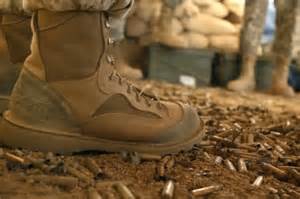
“We’re not considering any open commitment. We’re not considering a boots on the ground approach.”

And there it was: “boots on the ground”. I was suddenly rankled. Since rankled is not a word that one uses, or even sees every day, I shall post the definition here:

to continue to cause keen irritation or bitter resentment within the mind; fester; be painful.

That describes my feeling toward “boots on the ground”, a catch phrase which, of course, refers to launching a real, full-fledged, military operation on foreign soil by sending in soldiers (who usually wear boots), and usually indicates that we, as a Nation, are ready to make a long-term commitment to a country or region, based upon real, though often fabricated evidence. Evidence that is more times than not spoon fed through the media to the general public. In order to keep the boots off of the ground we often instead, launch an air strike.  An airborne attack has the advantage of inflicting massive damage  (shock and awe), while making certain that NO boots touch the ground – supposedly.

Boots on WHAT ground, I always want to say when I hear that tired expression circa. 2002. We have boots on the ground in the desert outside of Las Vegas launching drone attacks in Afghanistan, while we have had boots on the ground for the past decade in the desert in Iraq – fighting in a war that was started on some very shaky, if not downright underhanded pretenses.

So don’t get my meaning wrong  here. I am not saying that there is never a time for “boots on the ground”, and I certainly mean no disrespect to those wearing the boots (anyone who reads my work knows that I am committed to the cause of better treatment for our veterans), but I fear that this Syrian mess is not one of those times, or so it seems to me, and unless I have been inhaling too much Florida swamp gas, it will soon prove itself to be just that.

bootsThis is a debacle in sheep’s clothing and I hope that we discover that before the first boots hit the ground.

Mahalo,

–Ed

W E Patterson's avatar

All in the family

This summer, the Emmy Award winning daytime drama (soap opera) General Hospital has been airing a subplot in which young Michael Corinthos Jr. (played by Chad Duell),  the son of local mob boss Sonny Corinthos, falls in love with his half-brother’s girlfriend, Kiki Jerome (played by Kristen Alderson). In typical soap fashion, happiness and joy will not last long for these two young lovers. Michael and Kiki’s romance soon sours when it is discovered that they are, in fact, first cousins.

Since I seem to recall that real life mob-boss, Carlo Gambino, was married to his first cousin, I wondered why in fictitious Port Charles, New York, such a taboo existed. If such a relationship didn’t stop the Boss of Bosses from achieving matrimonial bliss with a not-too-distant relative, then why should it short circuit young Michael and Kiki’s plans? I mean, there are lots of other notable first cousin unions, notably Edgar Allan Poe who married his first cousin, Virginia Clemm, H.G. Wells who married cousin Isabelle, and Jesse James (the frontier outlaw, not the biker-reality-tv-star), who married first cousin Zerelda Mimms.

The list of cousin couplings goes on and on, and includes none other than Albert Einstein who married first cousin Elsa and of course, Jerry Lee Lewis who married first cousin, once removed, Myra Gayle Brown. Perhaps the most fascinating union, to me anyway, is the that of Charles Darwin who married first cousin Emma Wedgewood. Darwin it seems, was not too keen on the idea of marriage to anyone, and apparently weighed his options carefully before finally taking a walk down the aisle back in 1839. The Darwins went on to have ten children, three of which died in infancy. His other children went on to live out perfectly normal lives with three being knighted by Queen Victoria.

With a little further research into the topic of first cousin marriage, I was able to unearth the fact that while first cousin unions are allowed in 26 of our 50 U.S. states (some with restrictions), such marriages are legal in all European nations, Canada and Mexico. Here in the U.S., about 1 in every 1000 marriages is a first cousin marriage, while in Japan the ration is about 4 in every 1000.

These figures become more shocking when one considers that by some estimates, 80 percent of all marriages throughout history have been cousin marriages! And more shocking yet when one considers that all of us on planet earth are no more distantly related than 50th cousins.

So that’s it. We are just one big, largely dysfunctional family, here on this rock riding around the sun. I will remember that the next time someone – a stranger – cuts me off, rips me off, or in some other way pisses me off. I shall do my best to remember that he/she is just a wayward relative behaving badly, like Cousin Jake who has a way of offending nearly everyone at the Thanksgiving Day dinner table, but gets invited back year after year because – he’s family.

I am thinking of family now, as I hear the war drums pounding, way off in the distance. Members of this human family are at it again, killing other family members in very inhumane ways in a country halfway around the world. Here in the U.S. political leaders seem to be trying their best to rally support for an attack – an attack on something, or someone. Support for an attack is slow to gather among the populace. A poll in today’s Washington Post indicates that six in ten Americans want no part of another military action in the Middle East – probably because we have been lied to about the reasons for past military interventions.

We can  hope that this one isn’t another in a long line.


Mahalo,

-Ed

W E Patterson's avatar

Thoughts on Greenland

A commercial airline pilot I know, who flies regularly between New York and Amsterdam, told me the other day that he had been watching the Greenland ice cap disappear for the past decade.

“Greenland,” I said. “Now there is a place I haven’t thought about in a long, long time.”  I had probably not given Greenland a second thought since the sixth grade when I was awarded a gold star in Ms. Ogelthorpe’s geography class for correctly naming Godthab as its capital, and largest city. And I do recall my uncle telling stories about Thule Air Base, that dated back to his days in the Army Air Corps during and shortly after WWII, but that’s about it for me and Greenland.

Of course, we all know Greenland – it is that white and icy looking projectile dangling at the top of the Mercator Projection maps that hang upon the wall of every classroom throughout the world. But few of us have ever traveled there (although after doing some research, and seeing the incredible beauty of the place, I am almost ready to run out and book a flight to Godthab, or Nuuk, as the capital is now called). In any event, there is a lot more going on up in Greenland than one would think, and some of it is not pretty.

For starters, how many of us here in the U.S. know that back in April, British amateur explorer Philip Goodeve-Docker, 31, died in a storm on the ice cap while participating in a 30 day, 400 mile, trans-Greenland trek. Mr. Goodeve-Docker and two companions were participating in an unsanctioned charity event to raise funds for the Queen’s Nursing Institute, when a fierce storm called a Piteraq descended upon the party. These storms originate out on the ice cap and sweep down the eastern coast of Greenland, often with winds in the 50 to 80 mph range. In the case of the storm that descended upon Mr. Goodeve-Docker’s party, the wind speed reached 160 mph. In the face of such wind, and with temperatures in the neighborhood of -4 F, rescue by helicopter was impossible. Mr. Goodeve-Docker was able to put in a last call to his parents in Britain via satellite phone, and a rescue effort was mounted. Unfortunately not in time.

In what can only be termed an understatement, North East Hampshire coroner, Andrew Bradley, recorded Mr. Goodeve-Docker’s cause of death, as “death by misadventure”.

But back to my point about the Greenland ice cap and how this whole thing might relate to climate change. In July, an iceberg twice the size of Manhattan has broken off from Greenland. This huge ice chunk has dislodged from the Petermann Glacier. You can read this here too. As noted in this article (for those of you who do not care for links), the University of Cambridge has determined that the rate at which these Greenland glaciers are melting has doubled over the past ten years – confirming what my airline pilot acquaintance tells me (not that I doubted the guy, if you can’t trust a pilot who can you trust).

Another ‘non-alarmist’ article, a link to which I shall post here, describes the sudden ice melt that NASA satellites have observed, with even the coldest locales experiencing a bit of a melt-down. The article goes on to say that the scientists are unable to determine whether or not the melting of the ice is due to global climate change, or due to natural causes.

So there you have it. Just a bit of news about somewhere you probably have not thought of in a long time. Perhaps we shall wish we had paid a bit more attention to far off Greenland when the Florida peninsula disappears underwater, and the date palms are sprouting just outside of Bridgeport.

Mahalo

Ed

W E Patterson's avatar

…wondering…a salesman’s last night on earth…

On Saturday night, Tulip called me from L.A. Some of you who have been reading EEOTPB since the beginning remember her. She is an old friend of mine who moved from Florida to California several years ago.

She asked if I could find a poem that I wrote ten or a dozen years ago. It was about a close friend of hers.

I found it.

———————–

…wondering…a salesman’s last night on earth…

…I’m wondering how it is tonight,

Out on Bass Lake, and out in Spirit Lake,

And in Grand Lake and on the Great Salt Lake,

Down in Lake Charles and out on Lake Shore Drive,

How is…

The tiny girl named Janie from the Woodsmen,

Is she making out tonight?

Did she save the napkin, or the night, or the dream,

Would we have made it without screaming, just us.

How about the others, like,

The young hooker with her scrubbed cheeks,

Loaded on George Dinkel and telling me once again,

That she had found her love and was returning,

To Pomona to attend Community College with,

Her friend from the dance company…

…nurse comes in to reload the morphine drip.

…was there a fight in Juarez, or was it the girl Cynthia,

I was waking up in the back seat of a cab – on,

The Stanton Street Bridge at dawn,

Wondering if that call had been from Harry,

Back at the Sioux Falls plant. Not caring then,

Not me because of the tremendous high.

If we sold another six hundred thousand,

Color television chassis south of the border,

I could not have cared less…or more.

I love the figures, but not the change,

Just the bottom line people back at the office,

They love when the numbers fly by quickly,

But not me…too much road time to care,

My concern is for the common people,

They say…

…they say I won’t last until dawn

…and I think of her, a young lady married to a man

Who couldn’t keep a job, and who drank each night,

Until he was oblivious to her and her cares,

Dawn. What a name for such a lady -such a timid name.

The last part of the night, the darkest part, will take him,

That’s what they say behind the curtain.

But I wait here, shackled like a tethered brood mare,

Chained to the misery of my last night on earth.

“Give ‘em Hell Harry,” I exclaim to no one in particular,

And I watch dawn break over Kansas City.

W E Patterson's avatar

A tale of three DUIs

#1 Karlie Tomica

Occupation: bartender

There are two kinds of mistakes that we can make – the ones that can be fixed, and the ones that can’t be fixed. I thought of this as I watched the sentencing last week of 20 year old Karlie Tomica, a young Miami Beach woman found guilty in the death of 49 year old Executive Chef Stefano Riccioletti, who was walking home after work at the Miami Beach Shore Club’s Terrazzo Restaurant at about 6am on January 29th of this year.

At about the same time Mr. Riccioletti was leaving work, Ms. Tomica happened to be doing the same thing – except in the case of Ms. Tomica, she was behind the wheel of her car, and she had, by her own admission, been drinking throughout  her shift. The paths of these two Miami Beach service industry workers would soon collide in the most unfortunate of ways, when Ms. Tomica’s vehicle struck Chef Riccioletti, catapulting the father of two into the driveway of the hotel.

Perhaps either out of fear, or out of oblivious alcoholic abandon, Ms. Tomica fled the scene, leaving Mr. Riccioletti to die in the street. Good Samaritan Jairo Fuentes witnessed the crash and followed Ms. Tomica’s car, calling 911 as he pursued her through the streets of Miami Beach to her Collins Avenue apartment. It was there that police would soon arrest her.

Last week, the tearful, self-proclaimed “Party Princess”, was sentenced in a Miami courtroom to serve four years in the penitentiary, followed by two years of house arrest, followed by 15 years of probation. In addition, her driving privileges were revoked for life. Also, in a unique but thoughtful sentencing twist, she is ordered to write a check to Mothers Against Drunk Driving (MADD) each year on Stefano Riccioletti’s birthday, the amount of the check to equal the age that Mr. Riccioletti would have been on that day.

The plea bargain that Ms. Tomica accepted saved her from what was thought to be an inevitable 30 year prison sentence.

#2 Donte Stallworth

Occupation: NFL wide receiver

On the morning of March 14, 2009, my wife and I were driving my niece to a Cosmopolitan magazine photo shoot at Nikki Beach Resort in Miami Beach (yes, the same place that Karlie Tomica worked).  It was early on a Saturday morning, so the trip to Miami Beach should have been a breeze, but it wasn’t. The MacArthur Causeway, a main arterial roadway that runs between Interstate 95, and Miami Beach, was shut down due to an accident that had occurred some hours before. As we crawled through traffic we could see the empty Causeway, and we could only speculate as to the nature of the devastating event that had caused it to be closed.

By the time we returned home that evening, television news was a abuzz with details about a deadly automobile crash on the MacArthur Causeway, a crash that involved none other than NFL wide receiver, Donte Stallworth. For those of you who may not follow U.S. professional sports, Mr. Stallworth is a professional football player of some repute. As such, he has enjoyed a successful career with the Washington Redskins, Philadelphia Eagles, New England Patriots, Cleveland Browns, and the Baltimore Ravens. In short, Mr. Stallworth is endowed with a great deal of athletic prowess and he has made a great deal of money on the football field.

In the early morning hours of March 14th, though, it was a severely impaired Donte Stallworth who was piloting his six-figure Bentley convertible across the MacArthur. Near the eastern end of the causeway, Mr. Stallworth struck and killed 59 year old construction worker Mario Reyes. Mr. Reyes was a crane operator who was hurrying to catch a bus home after his shift ended at a nearby work site. Reyes was, by police reports, not within the crosswalk, a fact not lost on Mr. Stallworth, who later stated that he flashed his lights at Reyes in an attempt to get him to move, as he bore down on him in his Bentley.

Toxicology reports determined that Mr. Stallworth was under the influence of both alcohol and marijuana, and on April 1st, 2009 police arrested the football star on charges of DUI manslaughter. He was released the next day after posting $200,000 bail. Mr. Stallworth later accepted a plea bargain in order to avoid years of jail time. He was sentenced to 30 days in the county lockup; 1000 hours of community service; and eight years probation. In addition, he received a lifetime revocation of his driving privileges.

Mr. Stallworth was released from custody on July 9, 2009 after spending 24 days in the County Joint. After being banned from football for the entire 2009 season, Mr. Stallworth has since been reinstated and continues to play professionally.

3

#3 John Goodman

Occupation: Polo Club Mogul

Travel with me now if you will, up Florida’s Turnpike to the very horsey community of Wellington. John Goodman (no relation to actor John Goodman) certainly had it all if anyone did – and perhaps he still does. Goodman was heir to a 1.4 billion dollar fortune, amassed by his father in the air conditioning and  heating business. Mr. Goodman founded the International Polo Club in Palm Beach, a really high end kind of place that attracted the ultra-rich, and the very famous, including Prince Charles and Princess Diana, Sylvester Stallone and Madonna. Personally, I am not up on my polo, so I don’t know who’s playing who, or how the game is played – but I do know how it starts – lots of cash.

On the evening of February 12, 2010, Mr. Goodman was drinking heavily at a charity event. After settling up a $200 bar tab (by the way, Mr. Goodman left the bartender a $60 tip), he barreled away in his Bentley, ostensibly, as he would tell the court in later testimony, to get a Wendy’s frosty before the ‘fast-food’ restaurant closed.

Ah well, the stories we tell ourselves…

In route to “Wendy’s”, perhaps for a frosty to cleanse his palate after enjoying a number of tequila shots, Mr. Goodman severely underestimated the proximity of an intersection and ran through a stop sign, ploughing his Bentley into a Hyundai driven by a 23 year old University of Central Florida engineering student named Scott Wilson. Mr. Wilson’s Hyundai, with Mr. Wilson still inside, was ejected from the roadway into a canal (we have lots of canals in South Florida), where he subsequently drowned.

Mr. Goodman, apparently unaware of what had just happened, rushed from his totaled Bentley to the comfort of a nearby barn, where a friend maintained a “man cave”. It was here that our Polo Mogul sought solace in a number of alcoholic drinks as he attempted to regain his composure before calling authorities. Small wonder his blood alcohol level would be nearly two times the legal limit when he was arrested on DUI manslaughter charges.

In the days since, much has transpired in this case. Mr. Goodman was in jail for some time, and then was released on house arrest (house arrest being somewhat more palatable when one’s house is the size of half a county).  But this is a slow winding case. Defended by Roy Black, one of the foremost defense attorneys in the United States, the future of Mr. Goodman is still unclear.

Although he received a guilty verdict in the case, Mr. Goodman has now won a new trial. This in spite of the fact that much has marred Mr. Goodman’s case, including his adoption of his girlfriend to help shelter his children’s assets from forfeiture. Fortunately for Mr. Goodman, a juror from his trial came forward with a confession that that juror had been less than forthright when being interviewed for a seat on the jury. Apparently, said juror’s wife had a DUI which the juror had failed to mention in the pre-selection interview.

Now all bets are off as Mr. Goodman looks forward to a second trial. He knows what he is doing. He has already paid a massive amount of money to his victim’s family (reported, but not confirmed to be, 46 million dollars). He has the best representation, and the best accommodations. He has also probably sheltered a fortune for the day he anticipates walking free.

As of this writing Mr. Goodman remains under house arrest in his Wellington, Florida mansion under 4 million dollars bail.

*

So there you have it. The story of the three DUIs here in Florida. All began with one common denominator – excess and recklessness. Three people are dead – all of them had years of life ahead.

Make of this what you will.

So I conclude…

Leave the last one on the bar my friend,

And call a cab.

Mahalo

Ed

W E Patterson's avatar

Disappearing fishing tackle sparks my short rant on Wal-Mart…

So there I was, last week, at my local sports equipment store. It is a chain store near my house that I go to on a regular basis, although I don’t need much of what they sell there. I don’t golf, my bad knees forced me off of the running circuit years ago, and I am far too old to need football pads, or baseball cleats. I go to this particular store for one thing only – fishing tackle. And they stock lots of it, or at least they did. That is why I was so surprised when I stopped by the other day to replenish my supply of 2 ounce pyramid sinkers, and found their once packed shelves were nearly empty…devoid of tackle.

Frustrated, I  hailed a young store employee to find out what was going on with the fishing tackle.

“We’re not stocking ‘fishing stuff’ any more,” he said, sounding almost happy about it. Then he waved his hand at the few rods that were still standing in their vertical holders, and the nearly empty racks where lures and spoons and hooks were once displayed, and the empty shelves that once held a multitude of tackle boxes, bait bubblers and sand flea rakes.

“Why would you get rid of the fishing tackle?” I asked.

He shot me one of those, isn’t-it-obvious looks, and then he replied. “We need more room for the Lacrosse gear.”

“Lacrosse gear,” I snorted, “you’re kidding me. This is South Florida – sport fishing capital of the world. The Fishing Hall of Fame is a few miles down the road. And you’re clearing out the fishing equipment to make room for Lacrosse gear? Where are we supposed to go now for rods and tackle?”

“Try Wal-Mart,” he said over his shoulder as he walked away, “they have about everything we have.”

“Wal-Mart,” I said. “I never shop at…,” but the young sales associate was long gone.

Of course I was about to ask him why a seemingly bright young man like himself, would possibly direct a customer to Wal-Mart. Didn’t he realize that as goes the fishing gear, so go the propane stoves, tents, and overpriced sneakers? The golf clubs, weight sets and treadmills will soon follow. In another year he’ll be directing disillusioned young lacrosse players to the Wal-Mart Super Store two miles up the highway, and shortly after that he may find himself filling out an employment application at aforementioned store…doesn’t he know that!

Wal-Mart, with roughly 2,200,000 employees (2011 figures), is the number one private employer in not only the United States, but the entire world. And frankly, I could care less if they had ten million workers, as long as they made some halfhearted attempt to pay them better. Their anti-worker message is articulated clearly in the recent events going on up in our nation’s capital. Scheduled to open six new stores in D.C., Wal-Mart axed plans to open three of them based upon the D.C. City Council’s elevation of the minimum wage to $12.50 per hour for so called ‘big box’ stores. Big box stores being defined as those stores with floor space in excess of 75,000 square feet and annual revenues of over 1 billion dollars.

Since by some estimates, each Wal-Mart worker displaces 1.4 local workers it only seems right to me that they pay their workers a livable wage, whether $12.50 per hour is a livable wage in the D.C. metro area is debatable.

In vast areas of the United States, especially in the rural areas of the Midwest, Rocky Mountain West and South, the appearance of a Wal-Mart Super Center is viewed with the same tepid enthusiasm that accompanies news that a new prison is coming to town. It may not be exactly the industry that they want, but at least it will bring jobs. At least their young people will have somewhere to go to earn a paycheck…you know those young people, the ones that for a multitude of reasons are unable to pack up and leave for greener pastures as a good Republican friend of mine suggested to me recently.

And bring jobs it shall, and they shall be derived from the displaced workers that once owned and staffed local businesses.

Or so this seems to me.

W E Patterson's avatar

Quotes we carry

Social media is awash these days in quotes, and I have to admit that I am a sucker for a good quote, be it from a deceased politician, company CEO, famous author, or Hollywood celeb. We used to have to wait for pearls of wisdom to filter down to us through the print media, but now we have quotes that we are free to use, download, send to Facebook friends, Tweet, or incorporate into blogs, as I have here at EEOTPB upon so many occasions.

Quotes lift us up, they make us laugh, and they make us sound worldly when we’re really not. An appropriate quote, delivered with proper timing can make or break you in corporate America.

One afternoon, half dozing through a staff meeting, I was roused from near slumber by a stammering colleague who seemed reluctant to commit to a plan for a product delivery. Waiting for the proper entrance into the fray, I responded with one of my favorite quotes by General George Patton:

“A good plan violently executed now is better than a perfect plan executed next week.”

Of course I attributed the quote to the General before delivery. The response was at first a subtle chuckling that rippled through the room, but my manager smiled and told me he liked my attitude. By the way — my colleague was soon asked to leave the company, and although I can’t say I was fast-tracked to a corner office, I wasn’t dismissed either. If there is ever a quote that shows balls-to-the wall commitment to getting the job done it is that one (depending upon the situation, skip the word ‘violently’, you never know how that is going to be taken). So remember it, oh Corporate Drones.

But there are quotes that hit us where we live, aren’t there? Have you ever printed out a quote, trimmed it neatly, and folded it into your wallet, or pocketbook? Has a particular quote elevated itself to “wallet status” – something you want to keep near you, to refer to when you are not quite sure of the shaky ground upon which you walk, or the future into which you enter, ready or not?

Maybe your personal quote is hand written on a  post-it note, folded five times and tucked behind your drivers license just in case you need it someday, or maybe it is in your pocketbook, written in the margin of your DayTimer, or some such, but you know where it is so you can find it always – that’s the kind of quote I am talking about – one that makes you think about life in a way you always knew that it should be thought of, but that he or she said it so well, and so much better than you could have.

The quote that I carry with me is a quote from the classic 1949 novel by Paul Bowles, “The  Sheltering Sky”. Bowles, if you recall, was the only child of a New York City dentist, a father who, according to reports, was a harsh father who left Paul as an infant to die on a window ledge during a winter storm. Perhaps such harsh treatment as an infant infused young Paul with a unique outlook on life. The stark finality, and reality of this quote, has garnered it a place in my ‘electronic’ wallet and I refer to it daily, although I can recite it by heart:

Because we do not know when we will die, we get to think of life as an inexhaustible well. And yet everything happens only a certain number of times, and a very small number really.”

In this passage Paul Bowles goes on to suggest that in a lifetime we only watch the full moon rise perhaps 20 times…

If you have a quote that you carry with you and it means something special to you, please feel free to share it here.

Mahalo,

–Ed

W E Patterson's avatar

Not much sun in the Sunshine State

For many of us, life is a set of mundane daily activities that distract us from world events. We trudge through our days, thinking that in the end our efforts will be rewarded. We think that our good deeds will bear fruit. Similarly, we believe that misdeeds will result in some sort of punishment. I’d like to think that the terrible person in the white Nissan that cut me off yesterday on I-95 will somehow suffer for this affront by having something bad happen to him, or her (nothing really bad, like an accident or anything, but something sort of bad like getting stuck in the drive-up at the bank for 45 minutes). But then something will happen that reminds me that this may not happen, because the world is not a fair place to live. The driver of the white Nissan may be, at this very moment, cashing in a winning lottery ticket

Saturday was one of those days for me – a day that something happened to remind me of how unfair the world can be. Here in South Florida the weather was miserable. Tropical storm Chantral had fizzled off of the coast, and was crawling northward. By mid morning, heavy storm clouds had gathered, as if to foretell events unfolding in a courtroom in Central Florida (okay, so now you know where this blog post is going). By mid-morning I had cancelled my outdoor activities, as lightning crackled across the sky in one menacing bolt after another. The Weather Channel said that the front would pass by 1 PM, but that didn’t happen, and by 3 the rain was coming down in torrents. Around 4, an explosion not unlike an artillery round being fired went off behind my house, and the power for half of the neighborhood went down as lightning struck a nearby transformer.

By six, after my wife finished her workday, we sloshed off to the bar at Cafe Med, a little place near the Deerfield Beach fishing pier, a block off of the water. Yup, you guessed it, not lots of people at the beach. The place was nearly empty. A few tourists (don’t ask me who vacations in Florida in July) were at the bar, and from the sounds of things they had been there for quite some time. A couple of locals sat at the bar staring grimly at the TV, which was tuned to live coverage of the George Zimmerman trial going on up in Orlando. The volume was muted so everyone was carefully monitoring the closed captions scrolling past.

At that time, the jury of six (Florida felony trials require only a jury of six), had asked for clarification of what constituted ‘manslaughter’.

“They are going to find him guilty of manslaughter,” said my wife. “That’s all he’s going to get, I just feel it.”

“I dunno,” I said. “I think he’ll walk.”

“No,” said my wife. “He killed that kid…that unarmed kid…he can’t just walk away free…can he?”

By the time we got home later in the evening, the rain had subsided, although sheet lightning flashed in skies over Miami forty miles to the south. Eventually, a Florida Power and Light crew arrived to fix the power problem, so for a bit we were distracted from the Zimmerman trial, as we watched a power company worker reset a giant transformer fuse while standing on the ground using a 35 foot pole – ah modern technology.

Sometime around 11, my wife received a text message from her sister in Philadelphia.

“Oh no,” she said. “It can’t be true – he’s been found innocent!”

And so it goes here in the Sunshine State. The predicted riots that would erupt in the wake of an acquittal did not occur, although today there are some reports of riots in Los Angeles. Locally though, there were protests, and lots of tears, but they were peaceful protests, as the reality of what had happened began to sink in.

Today, conservative rock star, gun advocate Ted Nugent has weighed in with a predictable comment, calling Zimmerman’s action “the purest form of self-defense there is“.  Really Ted? Shooting an unarmed man is pure now?

The talking heads on the morning shows still speculate on the verdict, and today the first juror has spoken. There will probably be an upcoming civil trial, and George Zimmerman will undoubtedly wish that he were somewhere else that night of February 26, 2012. Trayvon Martin would certainly wish the same – if he only could.

As time goes on, we will discover more about the jury’s reasoning in finding Zimmerman not guilty. I imagine that Florida’s controversial ‘stand your ground law’, which pretty much makes it possible to gun down anyone whenever you feel threatened, is to blame. That, a six member jury, and some very good lawyering on the part of the defense probably were responsible for Zimmerman’s leaving the courthouse a free man.

To all, stay safe, and to my fellow Floridians, keep our laws in mind when your ire is roused by errant drivers, or that rude guy who edges his cart ahead of you at Publix. Remember the fine line that we have drawn in our sand – we might be but one altercation away from finding ourselves in Trayvon Martin’s shoes.

Mahalo

–Ed

W E Patterson's avatar

My post vacation thoughts…

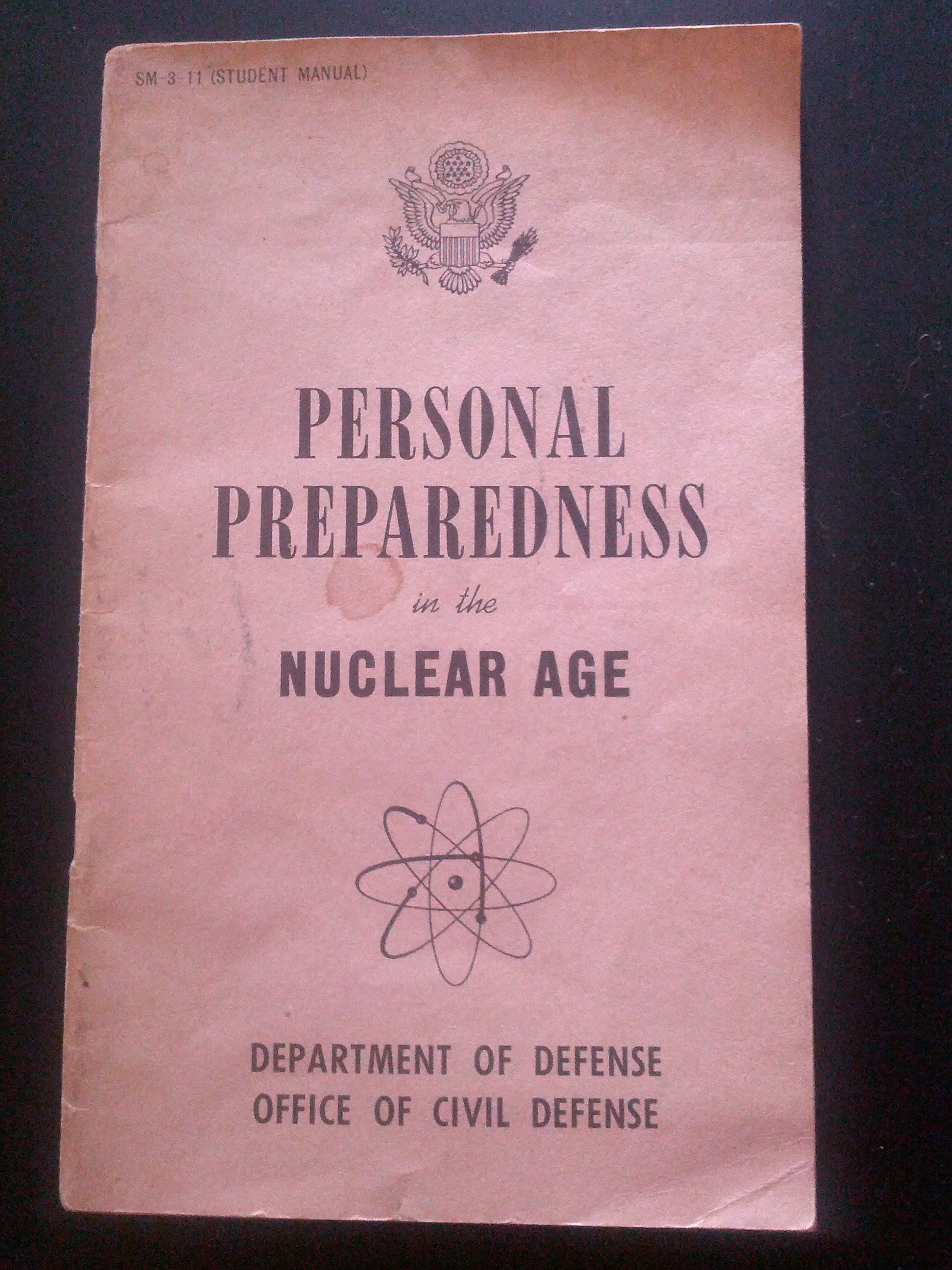
civil_defense_manualThis blog has suffered greatly these past couple of weeks, as professional demands, as well as lack thereof, have taken a toll on my writing schedule. Translated, that means that after working like hell for quite a while, I went on an eight-day vacation and didn’t write a line. Seldom do I vacate for eight entire days, but this year was an exception, and although I did not travel far (only 125 miles up the Florida coast), I was officially, ‘away’, and when I am ‘away’ I try not to touch a computer keyboard. This year I almost made it through without touching fingers to keys, and if it were not for the need to post an item for sale on Craigslist, I would have succeeded in keeping my vacation ‘computer free’.

I also try not to watch too much network news. I mean is there really any need to be completely informed on all matters at all times. Since there is little threat these days that ‘The Big One’ will be dropped on us at any time, I see no need to stay connected to international affairs 24/7. I recall reading a Civil Defense book that we had in our home when I was a child. I remember the chilling photos of the mushroom cloud rising over a distant city, as a family hunkered down in their well stocked fallout shelter, hopefully safe from annihilation in a wake of a gazillion megaton nuclear blast, that in reality would have vaporized them along with their supply of canned tomatoes and bottled water.

This particular Civil Defense guide went on to suggest that farmers take transistor radios to the fields with them during times of international tension, in order to monitor unfolding events. Presumably, they would be able to get the tractor tucked safely in the barn, should a flight of ICBMs be tracked coming in over the pole. Ludicrous indeed. As time went on, and the sixties unfolded into the seventies, these Civil Defense guides disappeared as we all accepted the grim reality that in event of such a man-made doomsday, there would be few, if not, any survivors.

Today, we seem to have little to fear from sudden and complete annihilation of the North American continent, however, our lives seem to be no more or less safe from destruction by events beyond our control.

The Orlando, Florida television stations, in the beachside community where I spent last week, preempted local news in lieu of live coverage of the George Zimmerman trial. Zimmerman, the armed community watch volunteer who seemed to go prepared for trouble, found it, and dealt with it using deadly force, is on trial for (what is effectively) his life. Meanwhile, the distraught family of the unarmed teenager felled by his bullet plead for justice. So it is a dangerous world, where walking in the wrong place, at the wrong time can mean deadly consequences. We are an armed nation, and there are lots of people packing heat and not afraid to use it – or maybe they just use it if they are afraid, who knows. Fortunately, this trial is coming to a head, and shortly justice will be served – hopefully.

Word of the tragic death of 19 Arizona firefighters came to me not over a network news station, but via The Weather Channel (TWC), as I tuned in one morning to ascertain whether or not the line of storms off of the Atlantic coast was a threat to the day’s fishing. I immediately turned to an NBC news report, delivered over my phone.

Finally, the crash of an airliner in San Francisco distracted me from fishing and beach.  As I paused to think for a moment about the two young girls who lost their lives in this ‘routine’ flight, and to consider how vulnerable we all are as we shoot through the skies from city to city aboard a mode of transport deemed safer than driving. Unlike the crash of the commuter plane in Buffalo a few years ago, in which the experience of the pilots is coming into question, this jet from Korea to the US had four pilots aboard for this long-haul international flight. The fact that it could crash upon landing, on a clear day, after making a successful flight across the Pacific Ocean is beyond belief.

The cause of this crash will take aviation experts, of which I am not one, months to investigate before a cause is determined. What I do find interesting is the news media’s continuing disbelief that the shaken passengers took time to gather personal possessions (even duty-free bags), before exiting the burning aircraft, as if these oblivious survivors put Ipods and scotch above human life as they malingered to gather earthly possessions. More than likely, these passengers were is shock in the few minutes immediately after dropping onto that San Francisco runway. I wrote a bit about this several years ago in an article about surviving a plane crash. You can read it here if you like.

So that’s it for now. Vacation is over, and I am back working and blogging. I am thinking about the fragility of life. As a new tropical disturbance crawls through the Caribbean I find myself thinking of how quickly our situations can change. If we are alive and relatively healthy we should consider ourselves lucky.

Stay safe.

Mahalo,

-Ed

W E Patterson's avatar

Remembering the Draft

Sometime back, during the Vietnam-war-torn year of 1969, a young California man named Dwight Stone went to his mailbox and opened a letter (much like this one) from the United States Selective Service. The letter began:

“Greetings:

You are hereby ordered for induction into the Armed Forces of the United States…”

Similar letters were received by more than 1.7 million other young men during the Vietnam War era of  1965 – 1973. Needless to say, such letters were met with varying reactions, ranging from quiet submission to fleeing the country for life in Canada, or Sweden. If you were a U.S. citizen, and a young man between the ages of 18 and 25 you had a draft card (unless you burned it as a few did in protest to the war), you were well acquainted with your local draft board, and you had plans to either volunteer for service, or to postpone service by obtaining a draft deferment. In any case, the thought of being swept off to fight in what was fast becoming a very unpopular conflict was a real possibility.

Mr. Stone, being little different than many young men his age, was less than enthusiastic about military service. As a man of little means, Mr. Stone lacked the funds to leave the country. In the words of Mr. Stone himself:

“I [sic] ain’t no Rockefeller.”

In the African-American, inner city community in which Mr. Stone lived, the war, by his own account, was not popular. As a poor man of little influence, he felt that his odds of ending up on the front lines, and returning to the States in a body bag was great indeed. Much greater than those whose families could afford to send their sons to college, thus gaining them an educational deferment, or to buy them a ticket out of the country.

So he did what he could. For three years, he attempted to avoid induction at all costs, including a failed attempt at a student exemption. When that didn’t work,  Mr. Stone went into hiding. Finally, with the U.S. Government nipping at his heels, an exhausted and frustrated Mr. Stone called his local draft board and turned himself in.

On June 30, 1973, Mr. Stone was inducted into the U.S. Army, thus earning him the distinction of being the last man drafted into the U.S. Military. This Sunday, we ‘celebrate’ the fortieth anniversary of Mr. Stone’s induction. Perhaps all for the best, no young man has been ordered to report since. One has to wonder if it were not for the unpopular Vietnam War, if we would not be calling young men (and perhaps young women) up today for service.

While young men have been drafted since the Civil War, the draft that spanned the Vietnam War period had actually been in place since 1940. Throughout the peacetime years of the late 1950s, men continued to be called for service, including perhaps America’s most famous draftee, Elvis Presley. Elvis reported for duty on March 24, 1958, after receiving his “Greetings” letter sometime around Christmas of 1957, while celebrating the holidays at Graceland. Of course there were few bullets flying in those days. The Cold War was in full swing though, and with the threat of global nuclear annihilation looming over us all, The King packed off to basic training. After basic, he shipped out to Friedberg, Germany where he served honorably in the 3rd Armor Corps’ 32n’d Tank Battalion, Company D.

By the time Elvis mustered out of service on March 2, 1960, to return to the recording career that had been kept alive by Col. Tom Parker, he had achieved the rank of sergeant, met a young girl named Priscilla Beaulieu, who he would eventually marry, and become a role model for countless young men who would come to view military service as a patriotic obligation.

In the years since, much has been made of Elvis’ off-base life style, where he lived with family, and entertained in comparative luxury compared to his fellow soldiers. While this is true, I still find it difficult to imagine any of today’s recording artists (think Justin Bieber), reporting for duty and shipping out for Iraq, or Afghanistan (no disrespect to ‘The Biebs’ intended). Times have changed far too much, and while we rightly rush to thank our servicemen and servicewomen for their service, a draft that would conscript a young person of Justin Bieber’s celebrity would be almost unthinkable.

So I am thinking about the draft today. Actually, I have thought about it on other days too, especially during the early days of the Iraq war. For a time, as it became increasingly evident that the rationale for this conflict was being framed using some very shaky facts, I wondered if the public would be more questioning of our involvement, if the draft were still in place. I remembered a saying I once heard that describes my feeling succinctly: “Let’s fight. Here, I’ll hold your coat”.

Oh yes, getting back to Mr. Stone. It seems he actually came to enjoy military life. He did his basic training at Ft. Polk in Louisiana, and after further training went on to become an electronics repairman at Ft. Richie, Maryland. Mr. Stone served honorably, and was discharged after serving 17 months. Today Dwight Stone works with disadvantaged youth in Sacramento, California. In a 1993 interview with the Seattle Times, Mr. Stone said:

“Serving your country is not a bad idea, as long as you include everybody,”

I have nothing more to add to that statement.

Mahalo,

-Ed